Goerz Triëder Monocle 6x15
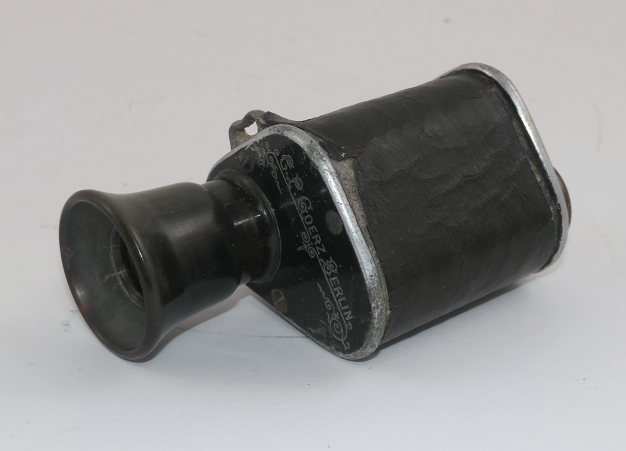
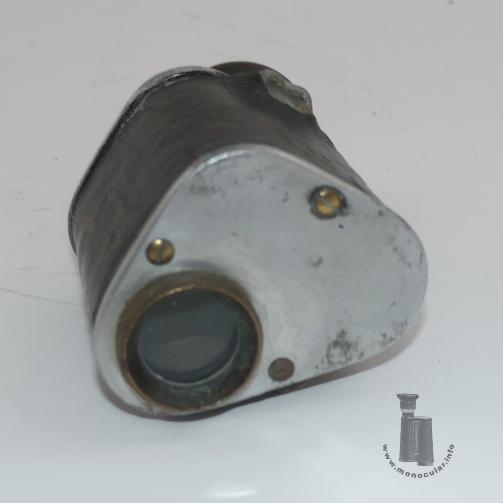
| Dies sehr frühes Triëder Monocle 6x noch mit 15mm-Objektiv und dem Firmennamen "C. P. Goerz Berlin" in verschnörkelter Jugendstil-Zierschrift wurde zwischen 1899 und 1904 gefertigt. Eine Seriennummer ist nirgends eingraviert. Es wurde in den Katalogen unter Modell Nr.20 und Codewort "Motribus" gelistet. Es hat eine Lederummantelung und Aluminiumdeckel. Die Fokussierung geschieht mittels eines 90° schwenkbaren Hebels (31mm) an der Seite, der innen mittels Zahntrieb das Okularstück bewegt (vgl. Goerz 9x20). Die Deckel in einer dreieckigen Grundform mit abgerundeten Ecken sind mit 3 Schrauben befestigt und sind oder waren schwarz lackiert. Das Okularstück, die Objektivfassung und der Hebel sowie dessen achtfach am Gehäuse angeschraubte Montageplatte sind aus Messing. Die 3/3 Augenmuschel ist aus Hartgummi ohne Kennzeichnungen. Auch die Vergrößerung ist nirgendwo angegeben. | This very early Triëder Monocle 6x-still featuring a 15mm objective lens and the company name "C. P. Goerz Berlin" in an floral Art Nouveau script—was manufactured between 1899 and 1904. No serial number is engraved anywhere on the instrument. It was listed in catalogues under Model No. 20 with the code word "Motribus". It has a leather covering and aluminum cover plates. Focusing is achieved with a side-mounted lever (31mm) that pivots through 90 degrees, internally moving the eyepiece assembly by means of a gear mechanism (cf. Goerz 9x20). The covers—which feature a triangular base shape with rounded corners—are secured by three screws and are (or were originally) finished in black lacquer. The eyepiece, the objective lens mount, the lever, and the lever's mounting plate (which is secured to the housing by eight screws) are all made of brass. The 3/3 eyecup is made of hard rubber and bears no markings. The magnification is also not indicated anywhere on the device. |
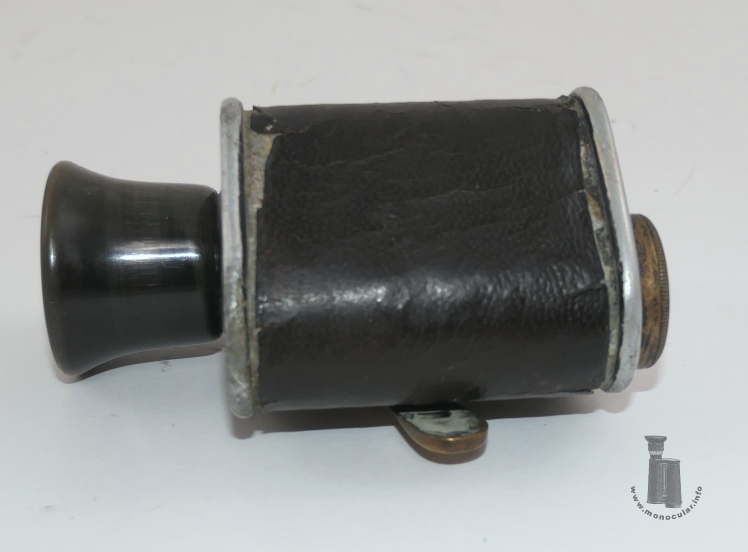
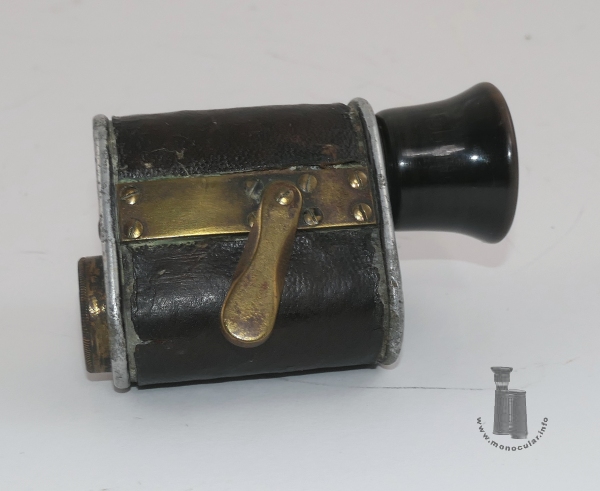
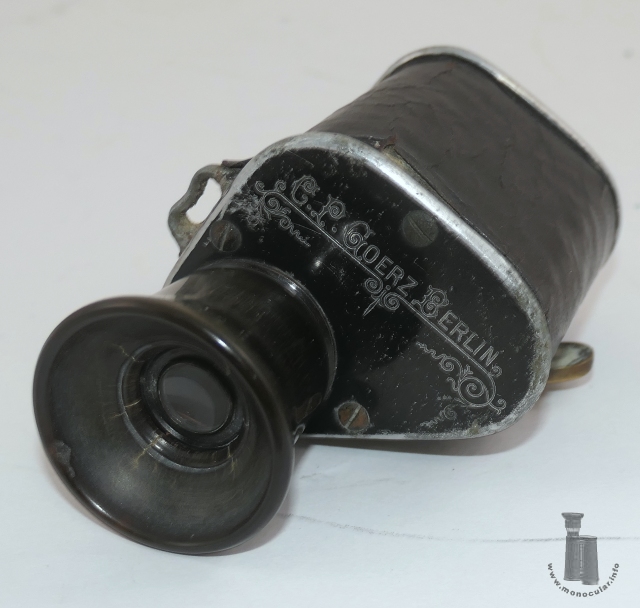
| Das Monokular wiegt 157g, es ist 45x45mm breit und 84mm bis 95mm lang. Die Objektivfassung ist 21,5mm im Durchmesser, das Okular 21mm und die äußere Augenmuschel 32mm. | The monocular weighs 157g, it is 45x45mm wide and 84 to 95m long. The objective frame measures 21.5mm in diameter, the ocular 21mm and the eyecup 32mm at its top end. |
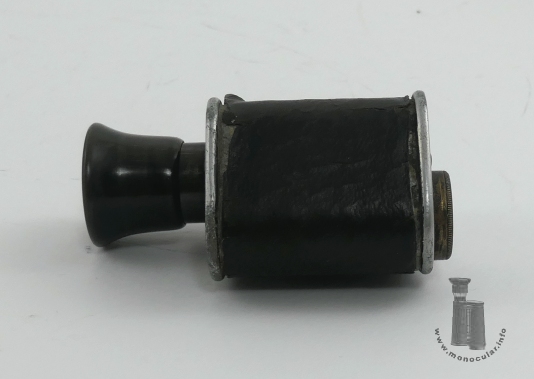
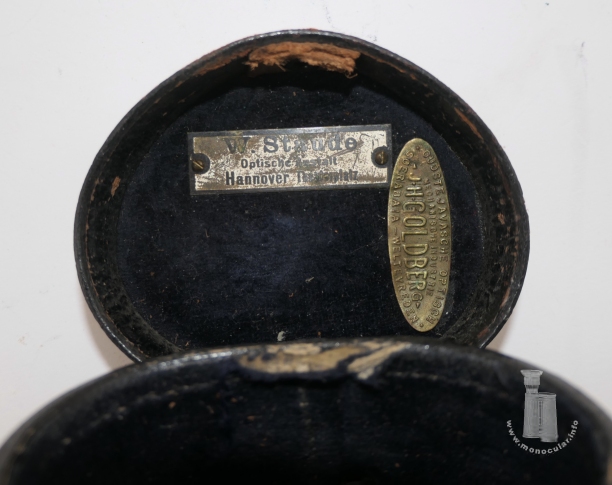
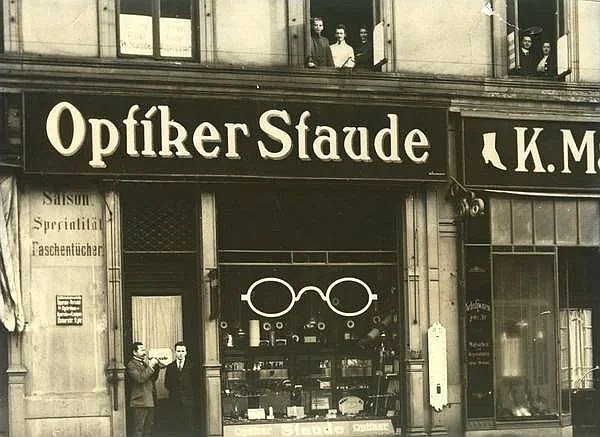
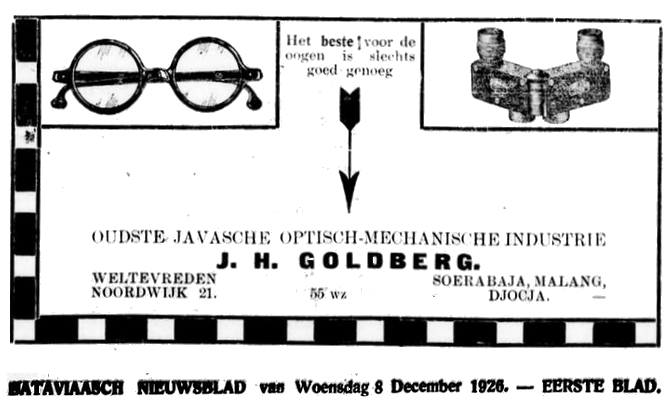
| Das Monokular befand sich in einem 114g schweren, 115x65x75mm großen Lederköcher mit zwei Händlerschildern an der Deckelinnenseite. 1. Ein mit zwei Schrauben angeschraubtes rechteckiges Metallschild mit der Inschrift "W. Staude Optische Anstalt - Hannover Theaterplatz" - , ein seit 1911 betriebenes Optikgeschäft am Theaterplatz 11 in Hannover (s. Foto), und 2. ein ovaler Aufkleber (in Goldfarbe) mit der Beschriftung "Oudste Javasche Optisch Mechanische Industrie • J. H. Goldberg • Soerabaia - Weltevreden", eine niederländische Optikfirma in Surabaya (niederl.: Soerabaia) und im Weltenvreden-Viertel in Jakarta (niederl.: Batavia) auf Java (s. Zeitungsreklame); die Niederländische Ostindien-Kompanie (VOC) war bis ins 20 Jh. in Niederländisch Indien, heute Indonesien aktiv!). Es könnte sein, dass das Monokular von Staude in Hannover aus nach Goldberg auf Java verkauft wurde, was dazu passt, dass der Köcher mit Instrument in Belgien 2025 erworben wurde. |
The monocular was housed in a leather case weighing 114 g and measuring 115 x 65 x 75 mm, featuring two dealer labels on the inside of the lid. 1. A rectangular metal plate, affixed with two screws, bearing the inscription "W. Staude Optische Anstalt – Hannover Theaterplatz"—an optical shop operating since 1911 at Theaterplatz 11 in Hannover (cf. photo); and 2. an oval sticker (in gold lettering) inscribed "Oudste Javasche Optisch Mechanische Industrie • J. H. Goldberg • Soerabaia – Weltevreden"—a Dutch optical firm located in Surabaya (Dutch: Soerabaia) and in the Weltevreden district of Jakarta (Dutch: Batavia) on Java )cf. newapaper ad). The Dutch East India Company [VOC] remained active in the Dutch East Indies—present-day Indonesia—well into the 20th century!. It is plausible that the monocular was sold from Staude in Hannover to Goldberg on Java—a scenario consistent with the fact that the case and instrument were acquired in Belgium in 2025. |
Fotos: Zeun