Kern Aarau 12x80 / 2x15
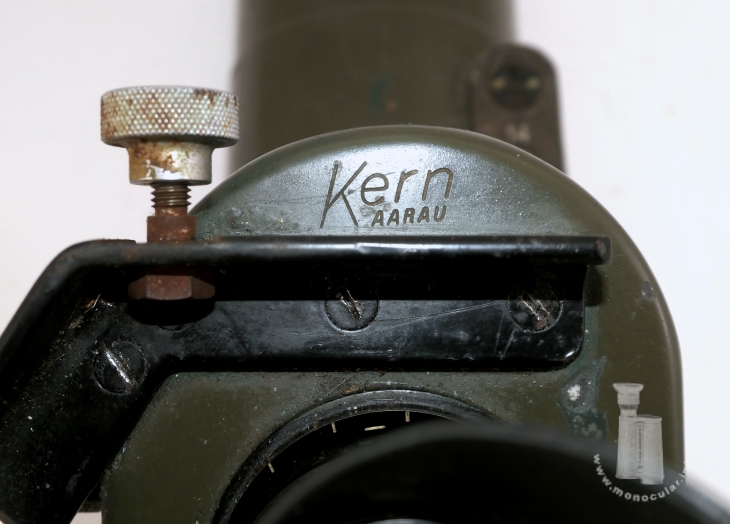
| Das Kern Aarau Richtfernrohr mit zwei umschaltbaren Vergrößerungen von 2fach und 12fach wirkt wie der kleine Bruder der größeren Hensoldt und FISBA Modelle mit Wechsel-Vergrößerungen. Außer der Firmenbezeichnung an der vorderen Gehäusewulst und einer "14" an der Beleuchtungseinheit gibt es keine weiteren Kennzeichnungen. Es ist anzunehmen, dass auch dieses Fernrohr bei der Schweizerischen Flugabwehr (Flab) an einem Geschütz oder Feuerleitgerät genutzt wurde oder dafür entwickelt wurde. (vgl. Info Webseite unten). | The Kern Aarau sighting telescope, featuring switchable 2x and 12x magnifications, appears to be the "little brother" of the larger Hensoldt and FISBA models with variable magnification. Apart from the manufacturer's name on the front housing rim and a "14" on the illumination unit, there are no other markings. It is reasonable to assume that this telescope was also used-or developed for use-by the Swiss anti-aircraft artillery (Flab) on a gun or fire-control unit (cf. the information website below). |
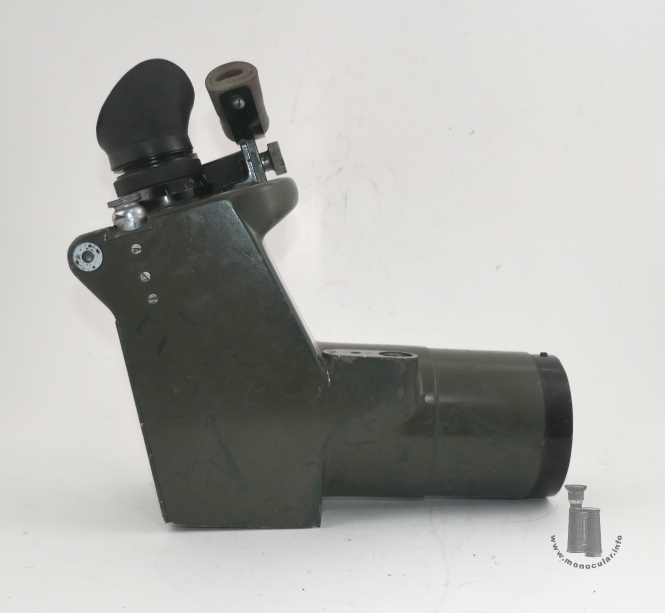
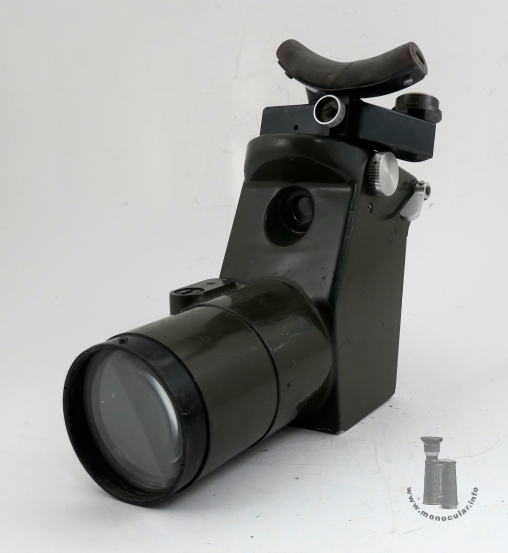
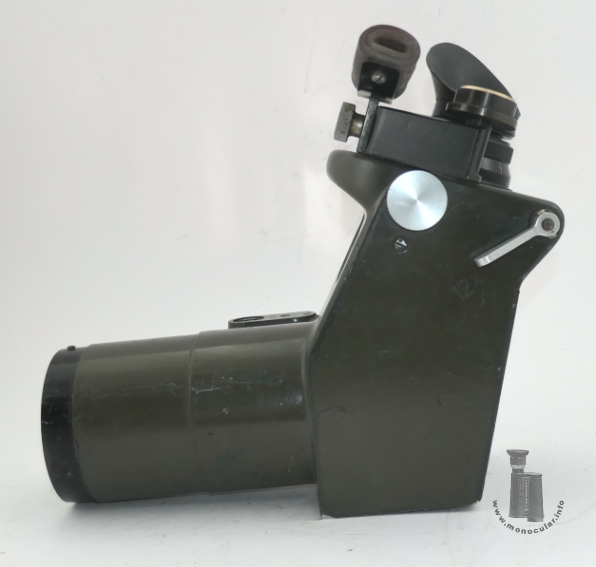
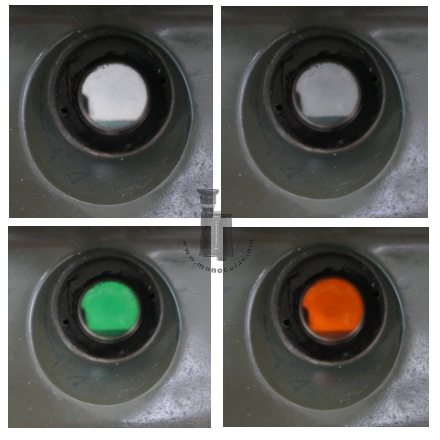
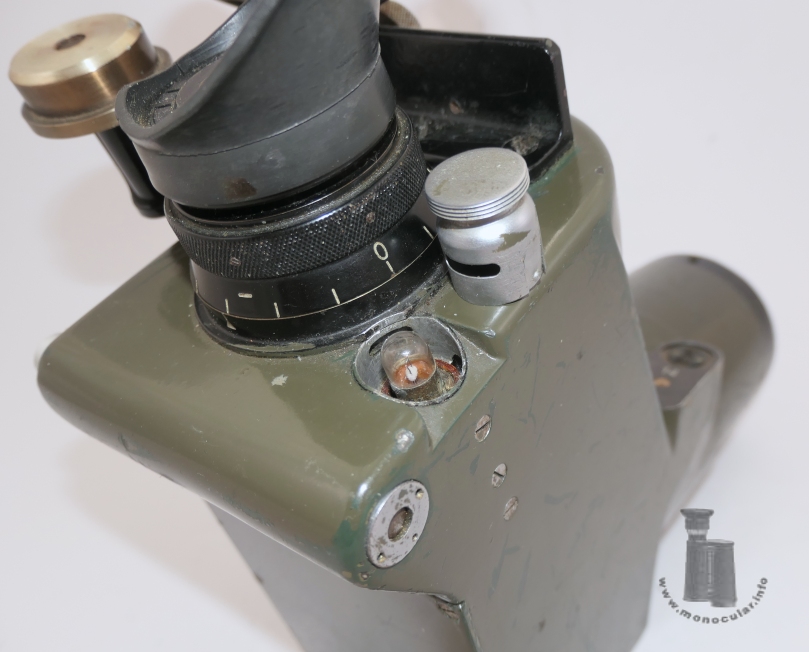
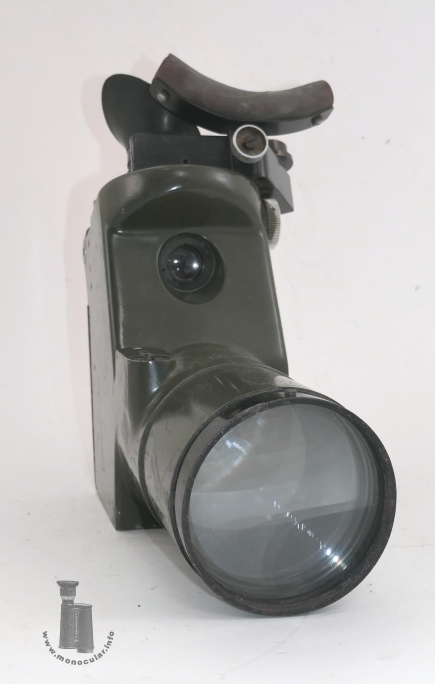
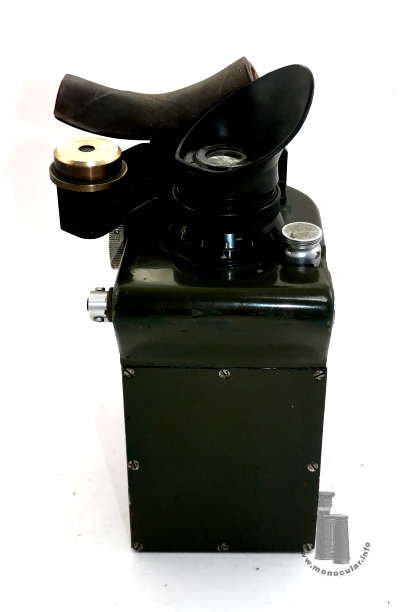
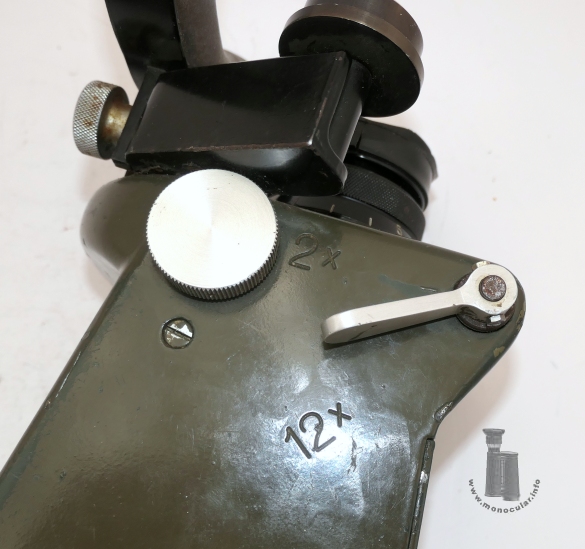
| An der linken Gehäuseseite befindet sich ein Hebel zum Umschalten zwischen den beiden Vergrößerungen. Diese Angaben sind am olivgrün lackierten Gehäuse. graviert. Ebenfalls ist vorne oben ein Rad zum Wechseln der Filter - klar, grau, grün, orange. Beide Stellvorrichtungen sind aus blankem Aluminium ohne Kennzeichnungen. Oben rechts am Gehäuse neben dem Okular ist eine Aluminiumhülse als Abdeckung und drehbaren Öffnung der Lampe für die Strichplattenbeleuchtung. Die Strichplatte ist ein durchgehendes Fadenkreuz. Das Okular mit 80°-Schrägeinblick hat eine Dioptrieneinstellung von plus bis minus 5 mit Okular-umlaufender Skalenstrichen. Der Fokussierungsring ist diagonal kreuz-geriffelt (x) und die Weichgummiaugenmuschel hat einen seitlichen Blendschutz. | A lever on the left side of the housing allows switching between the two magnifications; these settings are engraved on the olive-green painted body. A dial at the upper front of this side is used to change filters-clear, gray, green, and orange. Both controls are made of bare aluminum without any markings. On the top right of the housing, next to the eyepiece, is an aluminum sleeve that serves as a cover and rotating aperture for the reticle illumination lamp. The reticle consists of a continuous crosshair. The eyepiece, featuring an 80° angled view, offers diopter adjustment from +5 to -5, with scale markings encircling the eyepiece. The focusing ring features a diagonal cross-hatch pattern, and the soft rubber eyecup is flared. |
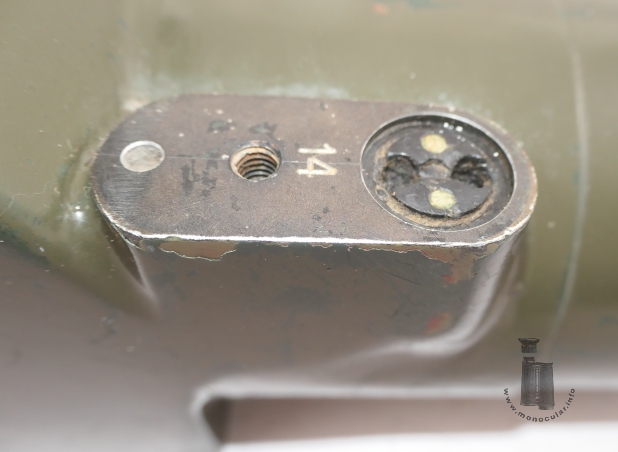
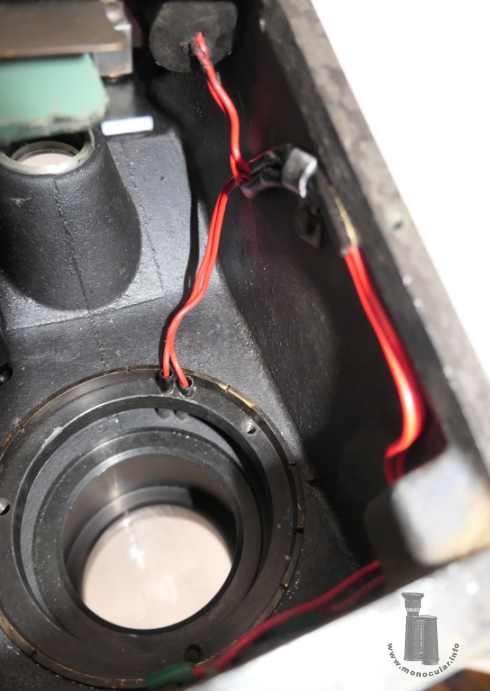
| Vor dem Okular ist auf dem Gehäuse eine Montageschiene, die links ein Blindokular (Augenmuschel fehlt) montiert und vorne eine abnehmbare Stirnstütze angeschraubt hat. Während die Okularlinse einen bläulichen Schimmer einer Vergütung zeigt, scheinen die beiden Objektivlinsen unvergütet zu sein. Dies würde eher für eine Produktion vor den 1960er Jahren sprechen, als Kern Ferngläser noch ohne oder mit Vergütung herstellte. An der äußeren Fassung des 80mm Objektivs ist eine Schraube, auf die eine Blendschutzrohr gesteckt werden konnte; dies ist jedoch nicht mehr vorhanden. An der rechten Oberseite des Objektivtubuses befindet sich ein länglich ovale Gehäuseteil mit einem Steck- und Schraubloch sowie einem isolierten Stromkontakt zur Montage einer weiteren Beleuchtung vermutlich für ein aufschraubbares Schnellvisier wie bei den anderen genannten Richtfernrohren (s. die Links oben). Die Unterseite des Gehäuses weist vier Montageschraublöcher sowie die typische Bodenplatte mit zwei Stromkontakten auf. Jeweils zwei Kabel führen innen zur Strichplattenbeleuchtung oben und zur Schnellvisierbleuchtung in den hinteren Objektivtubus (s. Foto). |
A mounting rail is located on the housing in front of the eyepiece; a dummy eyepiece (eyecup missing) is mounted on the left side of this rail, and a detachable forehead rest is screwed onto the front. While the eyepiece lens shows the bluish tint of an anti-reflective coating, the two objective lenses appear to be uncoated. This suggests manufacture prior to the 1960s, a period when Kern produced binoculars both with and without such coatings. A screw on the outer mount of the 80mm objective lens allowed for the attachment of a sunshade; however, this component is no longer present. An elongated, oval housing section is located on the upper right side of the objective tube; it features a mounting socket and screw hole, as well as an insulated electrical contact for an additional light source—presumably for a screw-on quick sight, similar to those found on the other tracker telescopes mentioned (see the links given above). The underside of the housing features four mounting screw holes and the characteristic base plate with two electrical contacts. Pairs of wires run internally to the reticle illumination at the top and to the rapid-sighting device illumination within the rear section of the objective tube (see photo). |
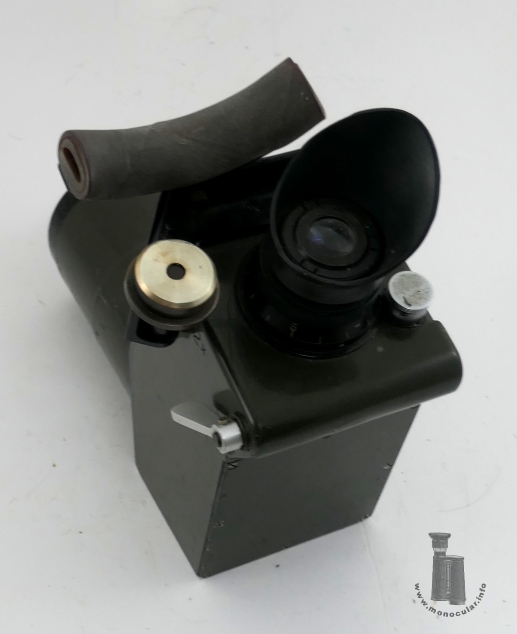
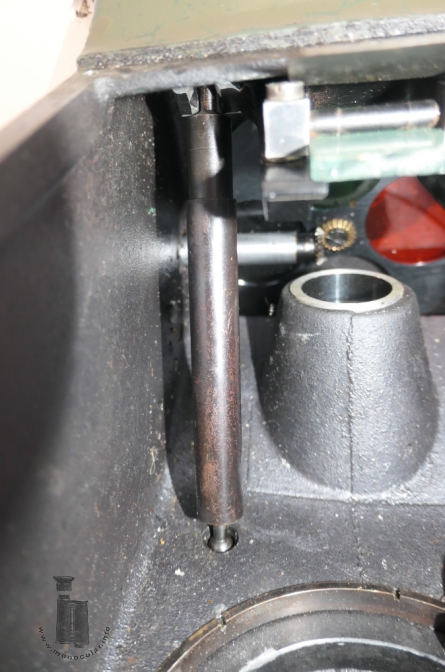
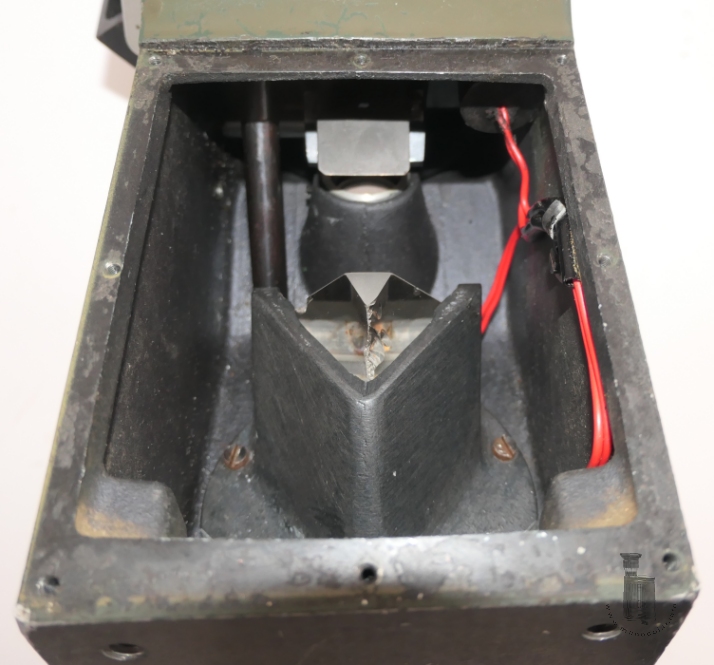
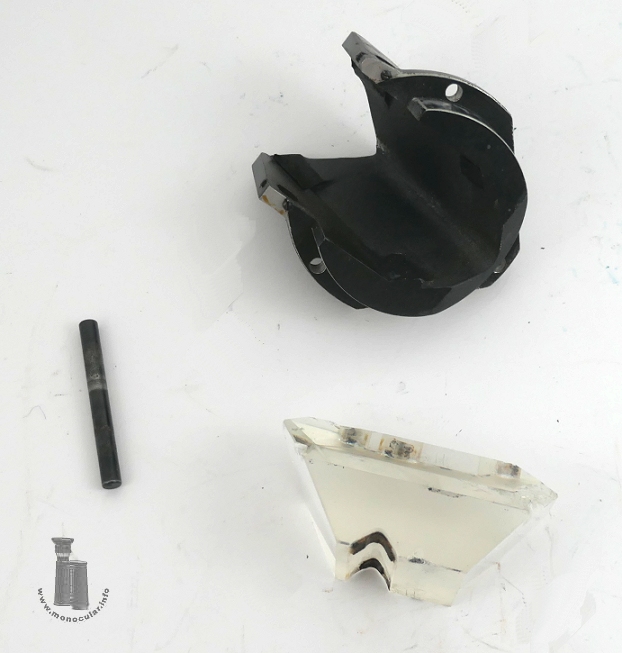
| Bei abgeschraubter hinterer Deckplatte lässt sich die Stromkabelführung (s. o.) und die Mechanik erkennen. Der Kipphebel schwenkt für die 2x Vergrößerung einen Spiegel diagonal in den Strahlengang, so dass das durch das kleine Objektiv einfallende Bild ins Okular geleitet wird. Dabei hält eine kugelgelagerte Federstange die Spiegelhalterung in Position. Die Drehung des Filterrads wird innen mittels Zahnrad auf eine Filterglasscheibe umgesetzt. Im Strahlenpfad vom großen Objektiv ist im Gehäuse auf einem Prismenstuhl ein großes Amici-Prisma mit Dachkante montiert und lenkt das Bild zum Okular, wenn der Umlenkspiegel weggeklappt ist (s. Fotos unten). |
With the rear cover plate removed, the power cable routing (see above) and the internal mechanism are visible. A toggle lever pivots a mirror diagonally into the optical path for 2x magnification, directing the image entering through the small objective lens into the eyepiece; a spring-loaded rod with a ball-bearing tip holds the mirror mount in position. Rotation of the filter wheel is transferred internally via a gear to the filter glass disc. A large Amici roof prism, mounted on a prism cradle within the housing, sits in the optical path of the large objective lens and directs the image to the eyepiece when the deflecting mirror is folded away (see photos below). |
| Das 4kg schwere Richtfernrohr ist 280mm lang (ohne Regenschutzrohr), 250mm hoch und 100 bzw. am Blindokular 140mm breit. Der Objektivtubus ist 90mm bzw. vorne 87,5mm, das Okularstück 55mm, der Fokussierungsteil 50mm und die Augenmuschel 46mm (60mm beim Blendschutz) im Durchmesser.
Ein fast gleiches Richtfernrohr wird im Fernglasmuseum.at gezeigt: Kern Aarau Geschützoptik 2x / 9x |
The 4 kg tracker telescope is 280 mm long (excluding the dew shield), 250 mm high, and 100 mm wide (or 140 mm at the dummy eyepiece). The diameters are 90 mm for the objective tube (87.5 mm at the front), 55 mm for the eyepiece section, 50 mm for the focusing unit, and 46 mm for the eyecup (60 mm for the flraed part).
An almost identical tracker telescope is on display at Fernglasmuseum.at:Kern Aarau "Geschützoptik" 2x/9x |
Fotos: Zeun