Ženijní Dálkoměr 25 (ŽD-25)
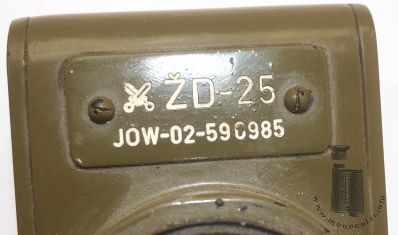
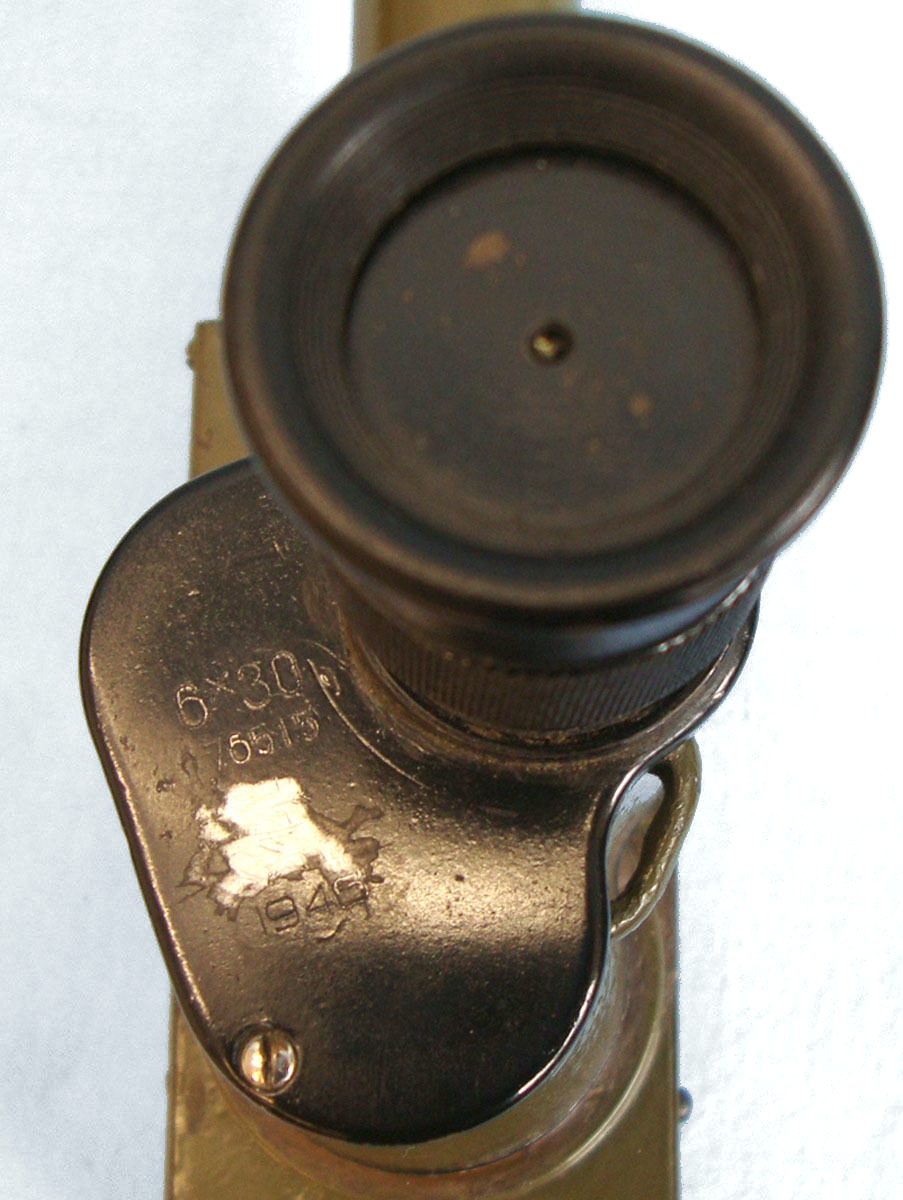
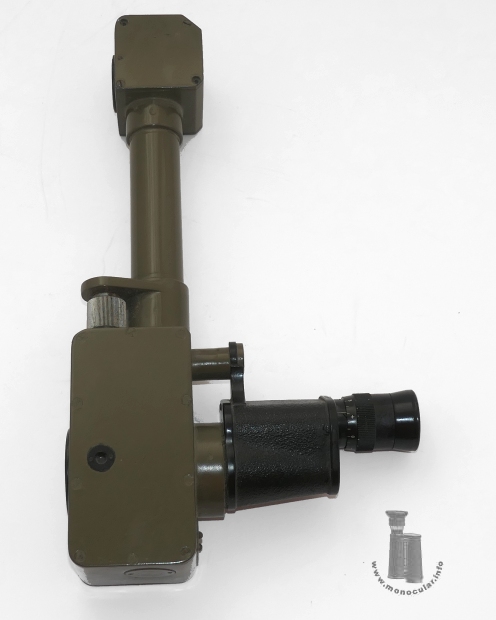
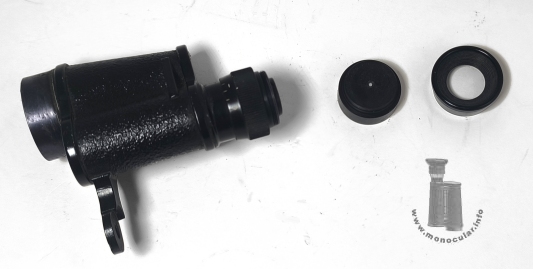
| Hier ist ein tschechischer Doppelbild-Entfernungsmesser mit einem 6x30 Monokular als vergrößernde Optik. Auf einem aufgeschraubten Schild am Gehäuse ist er als Modell ŽD-25, Ženijní Dálkoměr 25 (Ingenieur-Entfernungsmesser, 25cm Basislänge) und mit den "kreuzenden Schwertern" als Zeichen der Tschechischen Armee gekennzeichnet. Die Herstellernummer ist "JOW-02-590985" (Ob es sich hierbei um den Herstellercode „jow“ für die Elisabethhütte GmbH, Sprottau in Schlesien - heute Szprotawa, Polen - handelt, bleibt fraglich; s. im Folgenden). Das Modell dürfte nach dem 2. Weltkrieg hergestellt und benutzt worden sein. Bei einem anderen Exemplar ist der Monokular-Gehäusedeckel mit den optischen Werten, einer Seriennummer, vermutlich den gekreuzten Schwertern oder einem Firmenlogo (nicht erkennbar) und der Jahreszahl 1940 beschriftet. Hierbei wurde wohl ein älteres Monokular/halbes Fernglas angebracht. Das Monokular-Gehäuse ist grün lackiert, während es beim vorliegenden Exemplar schwarz ist. | Here is a Czech coincidence rangefinder featuring a 6x30 monocular as the magnifying optic. A plate screwed onto the housing identifies it as model ŽD-25 (Ženijní Dálkoměr 25—Engineer's Rangefinder, 25 cm base length) and bears the "crossed swords" emblem of the Czech Army. The manufacturer's number is "JOW-02-590985" (It remains questionable whether this refers to the manufacturer code "jow" for Elisabethhütte GmbH, Sprottau in Silesia—now Szprotawa, Poland; see below). The model was likely manufactured and used after World War II. On another specimen, the monocular housing cover is marked with optical specifications, a serial number, presumably the crossed swords or a company logo (indistinguishable), and the year 1940; in that instance, an older monocular—or half of a pair of binoculars—had evidently been fitted. The monocular housing on that unit is painted green, whereas on the present specimen, it is black. |
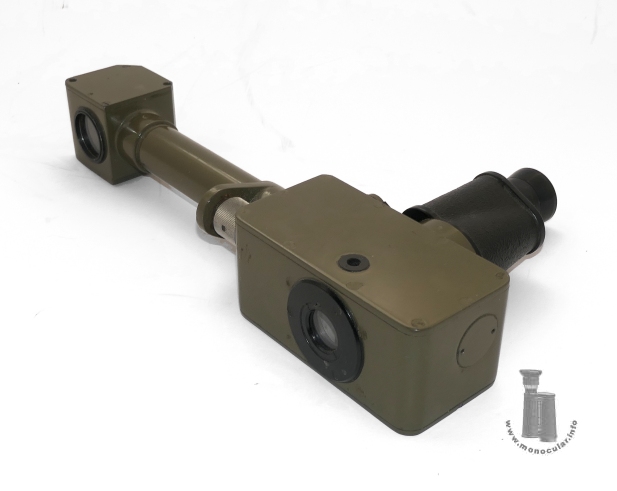
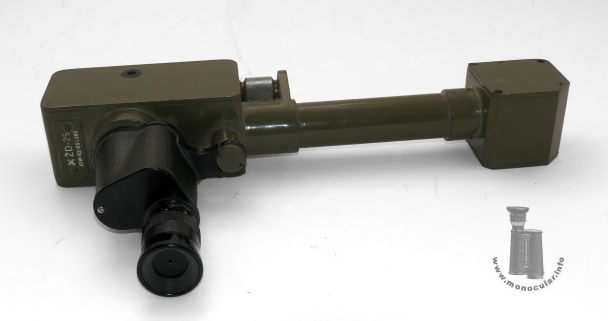
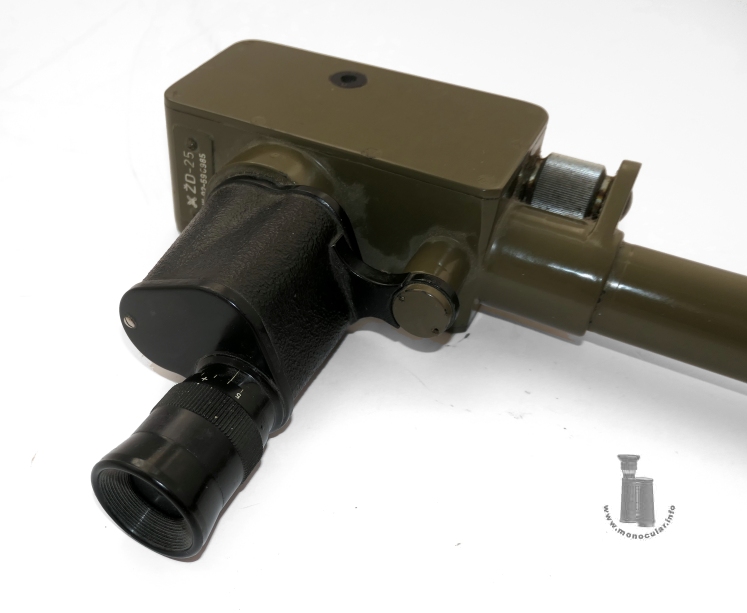
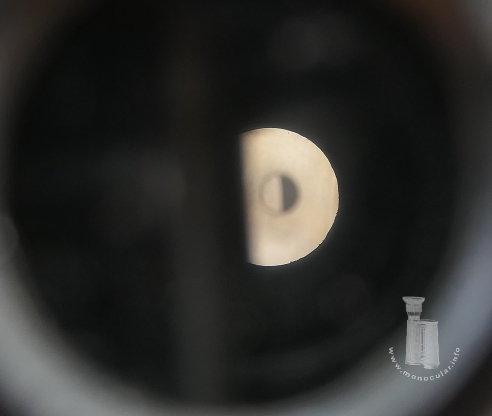
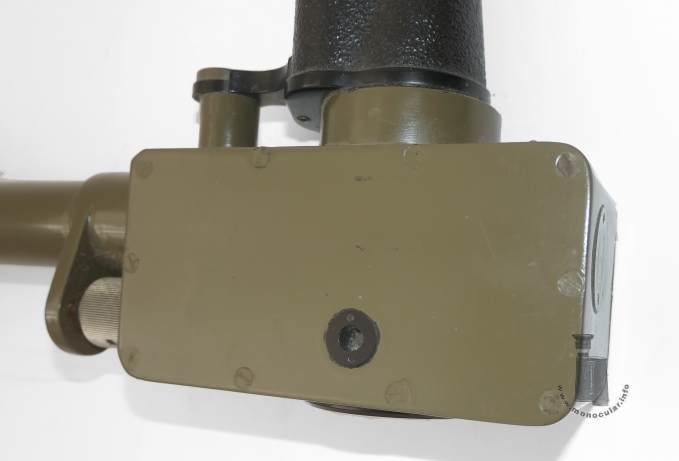
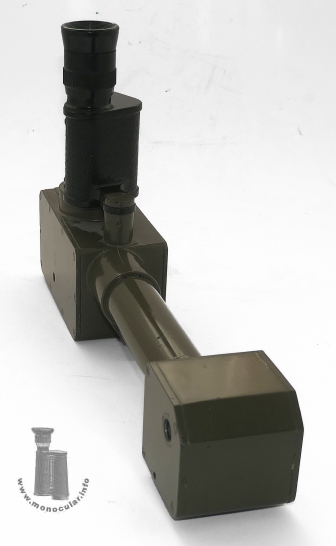
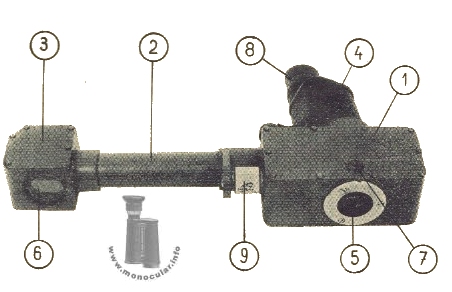
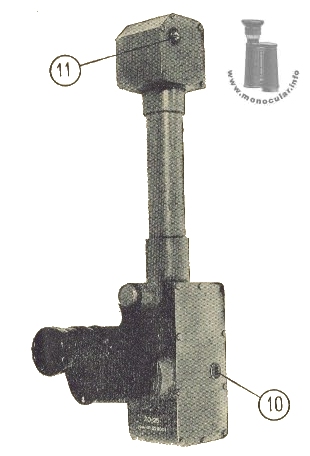
| Das dunkelgrün lackierte Instrument hat einen kastenförmiges Gehäuse mit einem 21mm Objektiv-Sichtfenster und einem gegenüberliegenden montierten 6x30 Monokular. Dies hat einen unteren Brückenarm, welcher zur Befestigung an einer Gehäusestange genutzt wird. An einer Seite des Gehäuses ist ein Rohr mit einem Prismenkopf mit einem 30mm Sichtfenster angebracht. Darin lenkt ein Pentagonalprisma das einfallende Licht durch das Rohr zum Hauptgehäuse um. Es entsteht ein Doppelbild, welches anhand einer Walze am Gehäuse (befestigt auch am Rohr durch einen Haltearm) justiert werden kann. Wenn das die beiden Bildanteile deckungsgleich sind, kann in einem kleinen, runden Fenster an der Gehäuseseite von einer Skala links der Parallaxenwinkel (-100" bis +1750" in 10"-Schritten) und rechts die Entfernung (30m bis ∞, unendlich) abgelesen werden. Gegenüber des Fensters ist ein weiteres rundes Fenster, um einen Lichteinfall zur Beleuchtung der Skalen zu ermöglichen. Zwischen Okular und Plastikaugenmuschel ist eine Lochblende eingeschraubt, um randschärferes Bild zu ergeben. Die Dioptrienskala reicht von plus bis minus fünf. Das optische System und die Skala sind in den abgebildeten Diagrammen aus dem Anleitungsheft zu sehen. Das Gerät kann als Entfernungs- oder Höhenmesser eingesetzt werden. | The dark-green lacquered instrument has a box-shaped housing with a 21mm objective viewing window and a 6x30 monocular mounted on the opposite side. The monocular has a lower bridge arm used to attach it to a rod on the housing. A tube with a prism head and a 30mm viewing window is attached to one side of the housing; inside, a pentaprism redirects incoming light through the tube to the main housing. This creates a double image that can be adjusted using a dial on the housing (which is also connected to the tube via a support arm). Once the two image components are aligned, a scale visible through a small, round window on the side of the housing allows the user to read the parallax angle on the left (-100" to +1750" in 10" increments) and the distance on the right (30m to ∞, infinity). Opposite this window is another round window that admits light to illuminate the scales. A pinhole aperture is screwed in between the eyepiece and the plastic eyecup to improve edge sharpness in the image. The diopter scale ranges from plus to minus five. The optical system and the scale are shown in the diagrams from the instruction manual. The device can be used as a rangefinder or a height finder. |
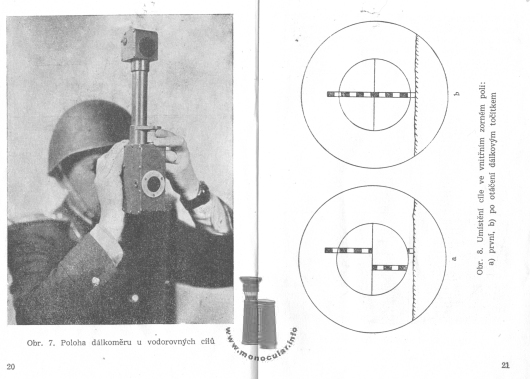
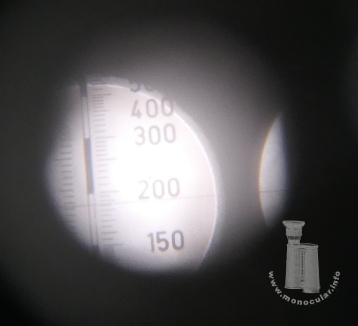
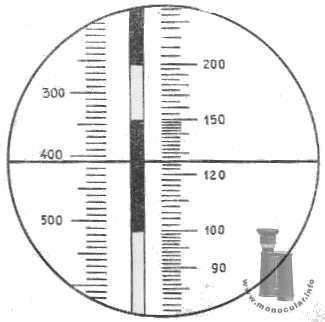
Aufbau des optischen Systems:
|
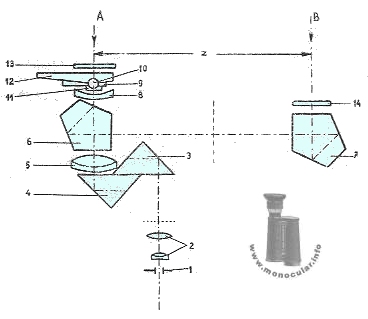
|
Optical system layout:
|
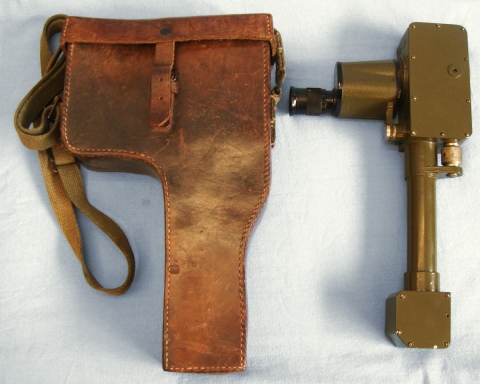
| Das ZD-25 ist 340 mm, das Hauptgehäuse misst 125x60x63mm (LxBxH). Das 155mm lange Rohr ist 31mm im Durchmesser. Der würfelförmige Kopf hat 54mm lange Seiten. Das Gewicht ist 1369g. Die runde Fassung für das Monokular ist 50mm im Durchmesser. Das Monokular selbst ist oben am Gehäuse 50x50mm und unten 55x57mm. Das Okularstück ist 27mm, der vertikal geriffelte Fokussierungsteil 32mm und die Augenmuschel 34mm im Durchmesser. Für das Instrument gab es eine passend geformte Ledertasche. |
The ZD-25 is 340 mm in length, with a main housing measuring 125 x 60 x 63 mm (L x W x H). The 155 mm long tube has a diameter of 31 mm. The cube-shaped head has sides measuring 54 mm. It weighs 1,369 g. The round mount for the monocular has a diameter of 50 mm. The monocular itself measures 50 x 50 mm at the top of the housing and 55 x 57 mm at the bottom. The eyepiece measures 27 mm in diameter, the vertically knurled focusing part 32 mm, and the eyecup 34 mm. A custom-fitted leather case was provided for the instrument. |
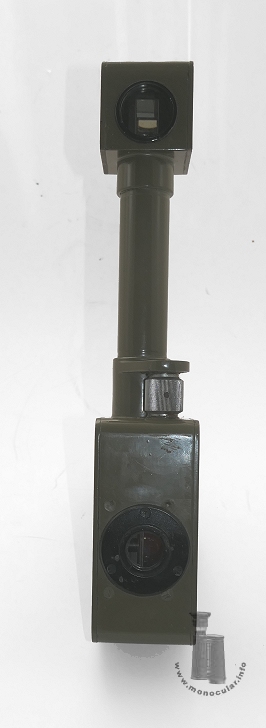
Aufbau des ZD-25:
|
ZD-25 Components:
|
Fotos: Zeun - 5 7,10,11,16,17 Anleitungsheft/Manual; 5, 18 Auktion