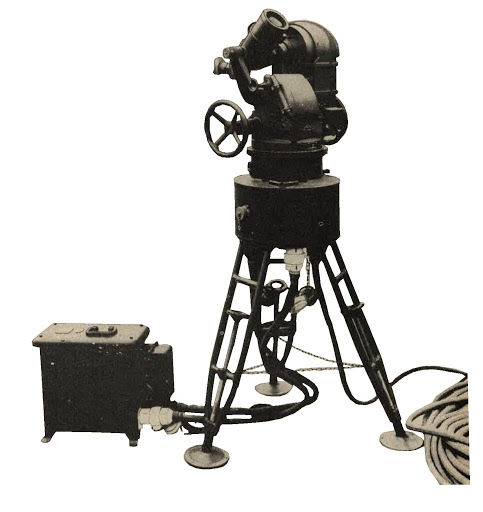
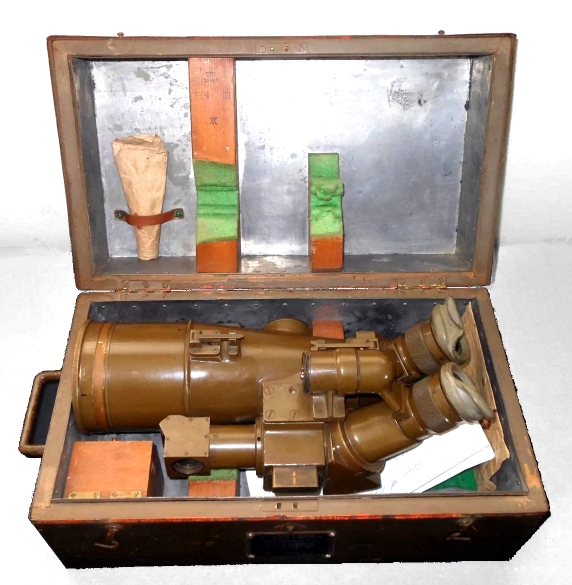
| Diese japanische Monokular mit den Werten 10x70 wurde zur Luftzielverfolgung mit Suchscheinwerfern benutzt. Daher hat es zum einen einen 45° Einblick (rechts), zum anderen ein zusätzliches Ablesefernrohr (4x24) mit Fokussierung bei ca. 20 cm. Das Instrument wurde auf einer Stativgabel montiert und als Scheinwerfer-Komparator*) verwendet. D. h. mit dem rechten 10x70 Monokular wurde ein Flugzeug verfolgt - das Okular hat eine Fadenkreuz-Strichplatte - und mit dem linken Ablesefernrohr ein Messwert einer Anzeige abgelesen (s. Foto des Fernrohrs auf dem gesamten Komparator-Instrument; diese Werte konnten entweder ggf. per Zuruf oder automatisch per Kabel an eine Suchscheinwerfereinheit, im weiteren ggf. Geschütz übermittelt werden, um diesen/dieses auszurichten. Eine Internetquelle besagt, dass die Ausrichtung auch mit Horch-Stationen geschah (Infos s. dort) **). | This Japanese 10x70 monocular was used for tracking aerial targets in conjunction with searchlights. Consequently, it features a 45° eyepiece (on the right) and an additional reading telescope (4x24) with a close-focus capability of approximately 20 cm. The instrument was mounted on a tripod yoke and served as a searchlight comparator*). In operation, the right-hand 10x70 monocular—equipped with a crosshair reticle—was used to track an aircraft, while the left-hand reading telescope was used to read a value from a display (see photo of the telescope on the complete comparator instrument; these values could be transmitted—either verbally or automatically via cable—to a searchlight unit (and subsequently to an anti-aircraft gun) to align them with the target. An online source indicates that alignment was also achieved using acoustic detection stations (see that source for details**). |
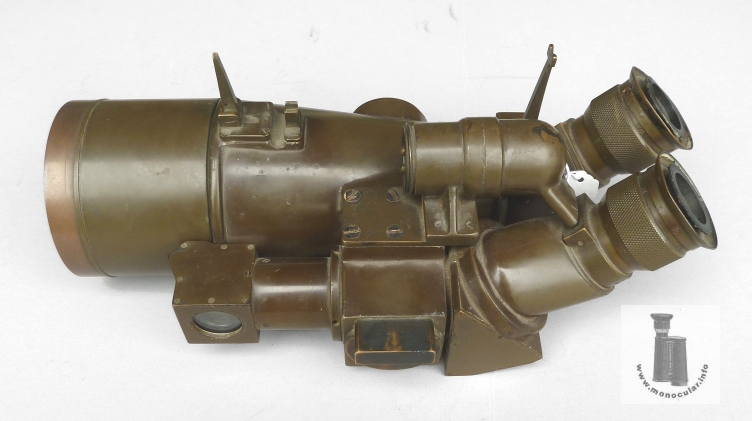
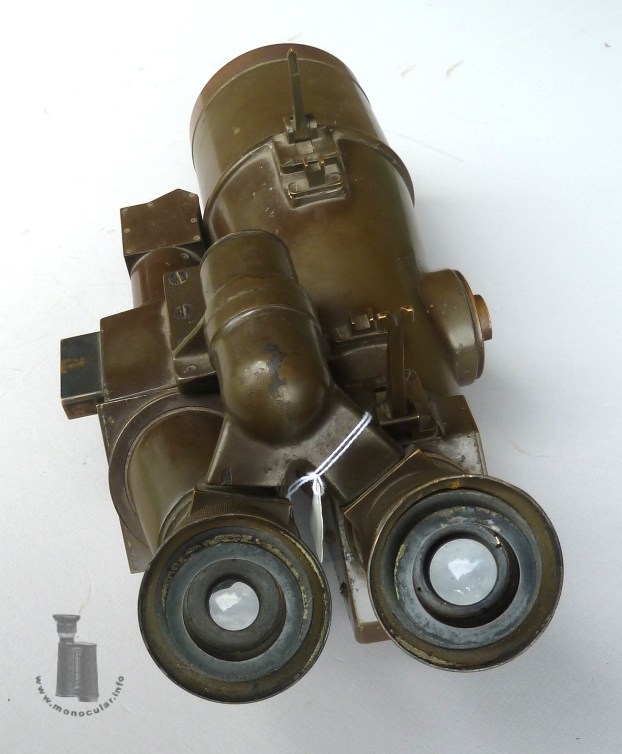
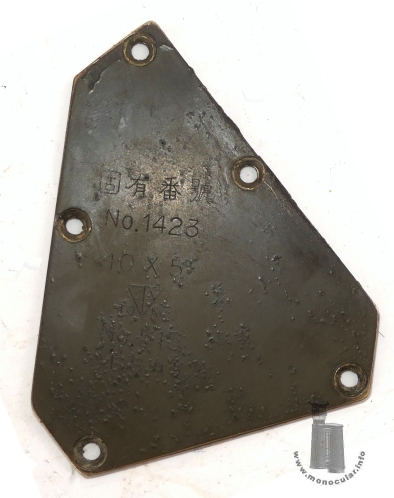
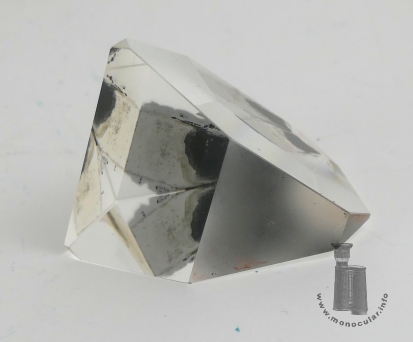
Der äußere Deckel des rechten Monokular ist in 6 Zeilen mit 4 Kanji Zeichen (Bedeutung derzeit unbekannt), No. 1423, 10 x 5°, dem TOKO-Logo 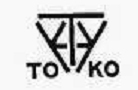 , No. 516 und JES sowie zwei Kanji Zeichen (= Japan Engineering Standard - screw type) gekennzeichnet (s. Detailfoto). , No. 516 und JES sowie zwei Kanji Zeichen (= Japan Engineering Standard - screw type) gekennzeichnet (s. Detailfoto).Die Optik ist unvergütet. Beide 45° Einblicke werden durch 45°-'Prismen mit Dachkante zur Bildumkehrung erreicht. Dabei ist das 45° Prisma des 10x70 Monokulars größer als das des Ablesefernrohrs. Im Objektivgehäuse des Letzteren wird der Strahlengang mit einem Pentaprisma um 90° umgelenkt. |
The outer cover plate of the right-hand monocular is marked with six lines of text: four kanji characters (meaning currently unknown), No. 1423, 10 x 5°, the TOKO logo , No. 516, and JES as well as two kanji characters for (Japan Engineering Standard – screw type) (see detailed photo). The optics are uncoated. Both 45° angled views are achieved by 45° prisms with a roof for image erection. The 45° prism in the 10x70 monocular is larger than the one in the reading telescope. In the objective housing of the latter, the optical path is deflected by 90° using a pentaprism. |
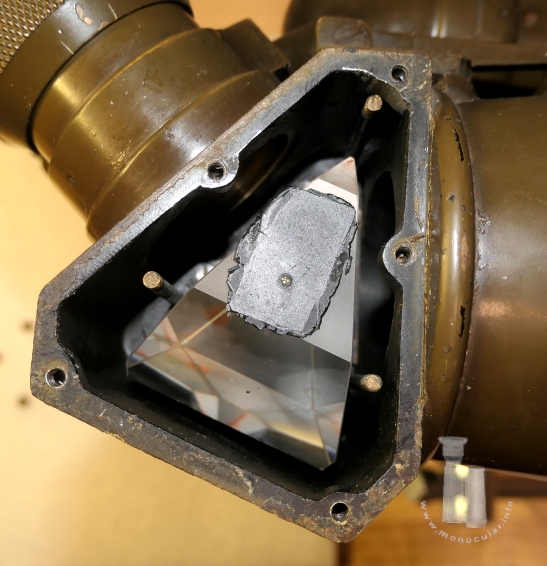
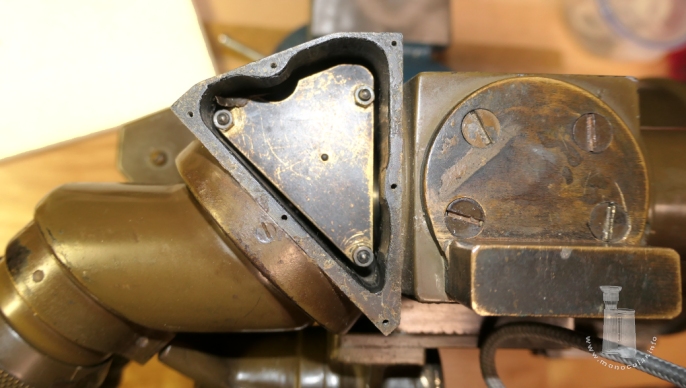
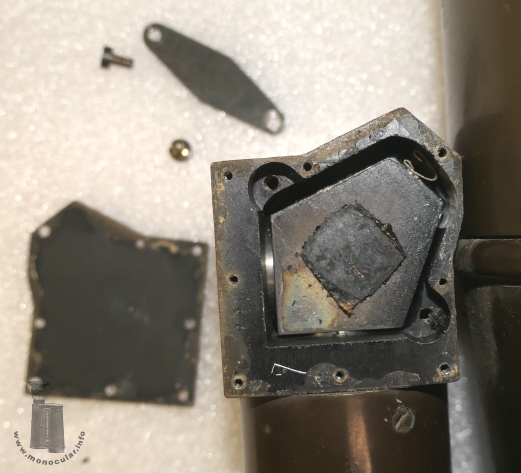
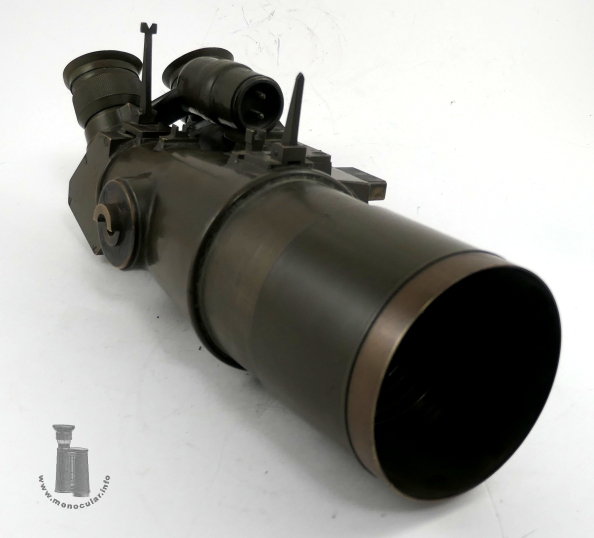
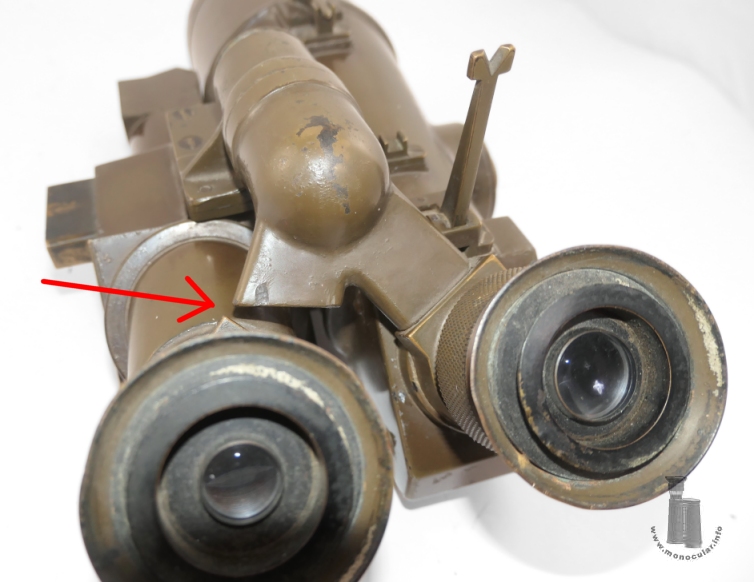
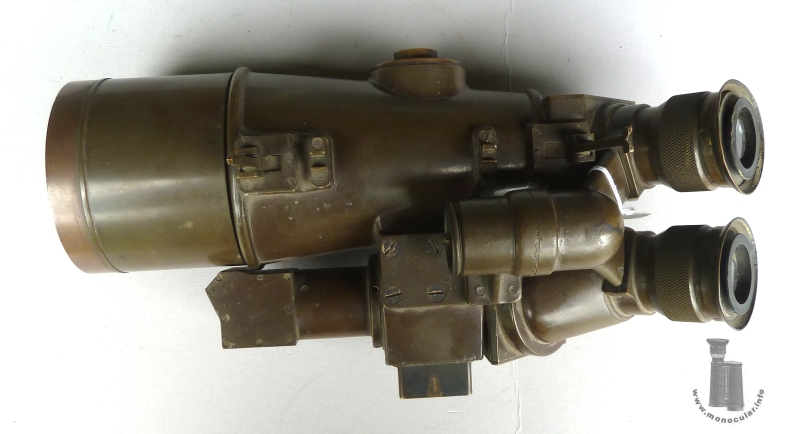
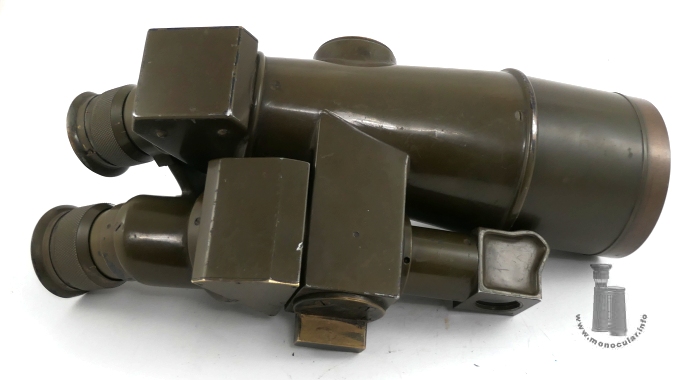
| Das Toko 10x70 ist aus Messing und grünlich-braun lackiert. Auf der Oberseite ist ein Kimme-und-Korn Visierhochklappbar. Am Objektiv lässt sich eine Sonnenblende ausziehen. Beide Okulare haben eine Dioptrienskala mit Teillinien zwischen plus und minus drei, beschriftet mit 0, + und -, die Fokussierungsteile sind diagonal kreuzgeriffelt, die Augenmuscheln (fehlend) sind auf einem Ring drehend montiert. Eine Beleuchtungseinheit ist links auf dem Gehäuse montiert, hat eine Lampenhülse mit Stromkontakten zum Objektiv hin und V-förmig angeordnete Lichtkanäle zu den Strichplattenfenstern der Okulare. Beide Okulare haben ein Fadenkreuz. Das rechte ist in Ausrichtung eines Pluses (+), das linke in Ausrichtung eines X's (x). Zum Ändern des Augenabstands lässt sich das linke Okularstück schwenken (der Lichtpfad wird mit einem Rhomboid-Prisma geleitet), wobei bei weiterem Augenabstand das Beleuchtungsfenster vom Lichtkanal ein Stück entfernt wird. Das Doppel-Monokular wird links mit einem rechteckigen und rechts mit einem halbkreisförmigen Zapfen im Scheinwerfer-Komparator aufgehängt. |
The Toko 10x70 is made of brass and finished with a greenish-brown lacquer. A flip-up iron sight (notch and post) is located on the top, and a sunshade can be extended at the objective end. Both eyepieces feature a diopter scale with graduations ranging from +3 to -3 (marked 0, +, and -); the focusing rings have a diagonal cross-hatch pattern, and the eyecups (which are missing) are mounted on rotating rings. A lighting unit is mounted on the left side of the housing; it features a lamp sleeve with electrical contacts facing the objective lens and V-shaped light channels leading to the reticle windows of each eyepiece. Both eyepieces have cross-hair reticles: the right one is a plus shape (+) and the left one is an X-shape (x). To adjust the interpupillary distance, the left eyepiece assembly can be pivoted (light path is guided by a rhomboid prism); as the distance increases, the illumination window moves slightly away from the light channel. The binocular unit is mounted on the searchlight comparator by means of a rectangular stud on the left side and a semicircular trunnion on the right. |
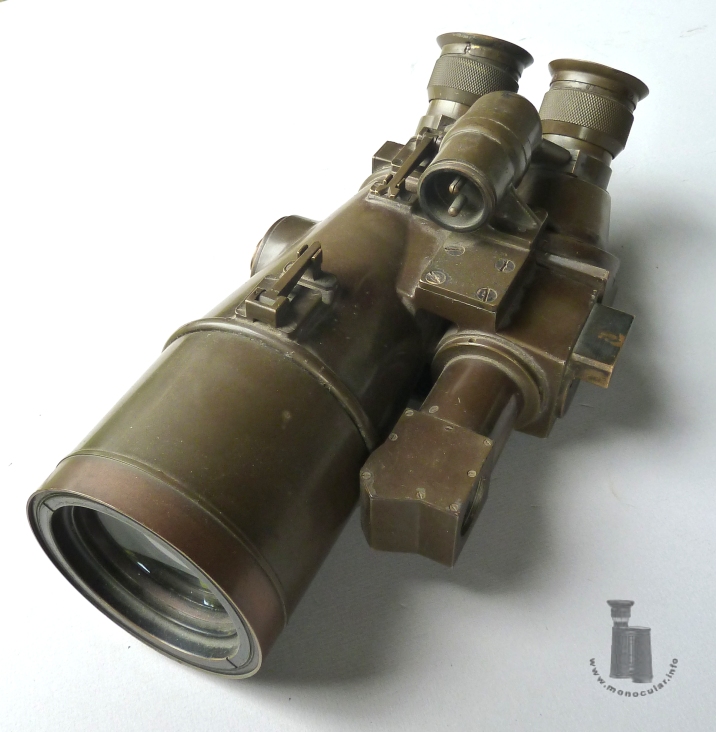
| Das Toko 10x70 ist 300mm lang - mit ausgezogener Sonnenblende 340mm -, 170mm breit und 120mm hoch. Die Okularstücke haben einen Durchmesser von 37mm, die Fokussierungsringe von 45,5mm und die äußeren Augenmuschelringe von 51mm. Der linke drehbare Okulartubus ist 50mm im Durchmesser. Der große konische Objektivtubus verbreitert sich von 65mm auf 95mm im Durchmesser, der gerade Endtubus ist 92mm und die Sonnenblende 97mm im Durchmesser. Der gerade Tubus des Ablesefernrohrs ist 36mm und die Lampenfassung 37mm im Durchmesser. Die Kimme ist 55mm und das Korn 45mm hoch. Das rechte Prismengehäuse ist 73mm hoch, 57mm lang und 55mm breit, während das linke 63nn hoch, 48mm lang und 65mm breit ist. Das Instrument wiegt 4,9kg. | The Toko 10x70 measures 300 mm in length (340 mm with the sunshade extended), 170 mm in width, and 120 mm in height. The eyepieces have a diameter of 37 mm, the focusing rings 45.5 mm, and the outer eyecup rings 51 mm. The left swiveling eyepiece tube has a diameter of 50 mm. The large conical objective tube widens from 65 mm to 95 mm in diameter; the straight end tube measures 92 mm and the sunshade 97 mm in diameter. The straight tube of the reading telescope has a diameter of 36 mm, and the lamp housing is 37 mm in diameter. The rear sight stands 55 mm high and the front sight 45 mm. The right prism housing measures 73 mm in height, 57 mm in length, and 55 mm in width, while the left measures 63 mm in height, 48 mm in length, and 65 mm in width. The instrument weighs 4.9 kg. |
|
|
Fotos: Zeun; 14 eBay