Carl Zeiss Jena 8x20 M
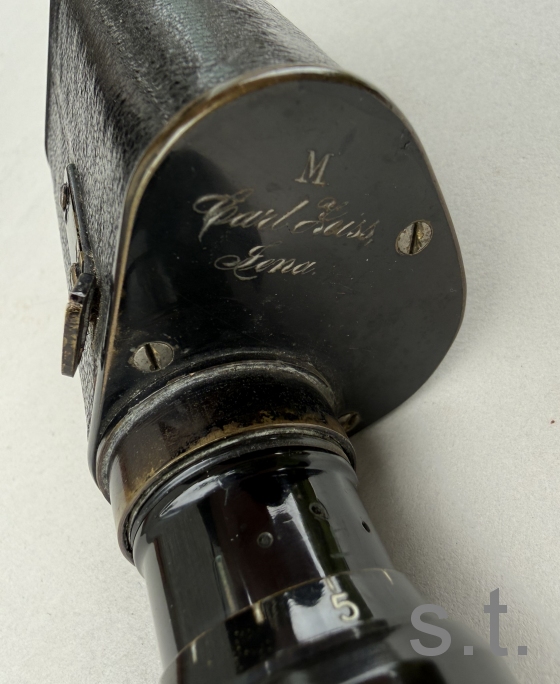
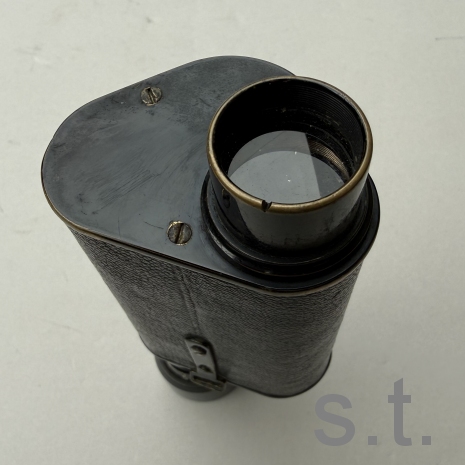
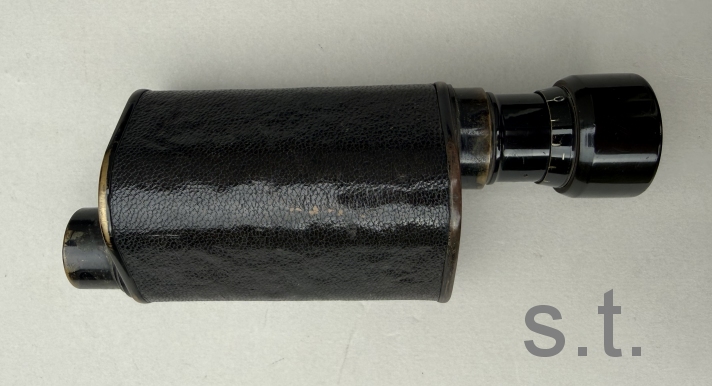
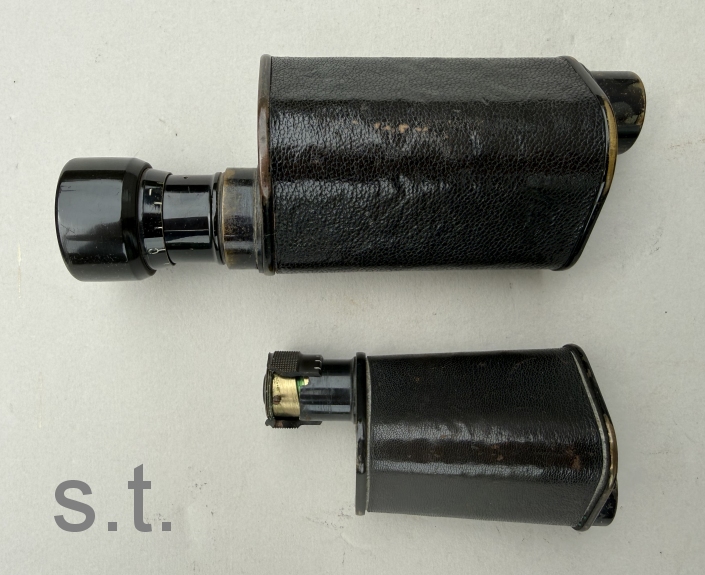
| Dieses 8x20 Monokular (Porro I)ist ein bislang unbekanntes Modell von Carl Zeiss Jena. Der Firmenname ist mit geschwungener Handschrift-Gravur in "aufrechter" Positionierung über dem Okularstück oder anders gesagt, um 90° nach links gedreht zu der üblichen Deckelbeschriftung. Darüber ist ein "M" graviert, dessen genaue Bedeutung nicht bekannt sit - es könnt für "Muster" (Versuchsmodell), Monokular oder Marine stehen. Das Gehäuse ist mit Leder ummantelt und hat eine zweifach angeschraubte Trageriemenöse. Die schwarz lackierten Deckel sind 3fach verschraubt. Abweichend zu den normalen 8x20 Modellen (s. letztes Foto) ist die größere Länge des Gehäuses, ein längerer Objektivtubus ohne innere Riffelung, ein Okularstück mit einem dickeren Ansatzring und einer geraden glatten 2/3 Augenmuschel aus Hartgummi mit inneren Rillen. Die Dioptrienskala verläuft ringsherum und ist von + bis - fünf markiert. Anhand der Merkmale dürfte es ungefähr zwischen 1898 und 1904 gefertigt worden sein. Unbekannt bleibt, ob es ein Prototyp ist oder für einen bestimmte, ggf. militärische Verwendung, hergestellt wurde. |
This 8x20 monocular (Porro I) is a previously unknown model from Carl Zeiss Jena. The company name is engraved in a floral script positioned "upright" above the eyepiece—or, in other words, rotated 90° to the left relative to the standard cover inscription. An "M" is engraved above this; its exact meaning is unknown, though it could stand for "Muster" (prototype/test model), "Monokular" (monocular), or "Marine" (navy). The body is leather-clad and has a strap lug secured by two screws. The black-lacquered covers are attached with three screws. Deviating from standard 8x20 models (see last photo), this unit features a longer body, an extended objective tube without internal knurling, and an eyepiece with a thicker collar ring and a straight, smooth, hard-rubber 2/3 eyecup with internal grooves. The diopter scale runs around the whole ring and is marked from +5 to -5. Based on these characteristics, it was likely manufactured between approximately 1898 and 1904. It remains unknown whether this is a prototype or a unit produced for a specific—possibly military—use. |
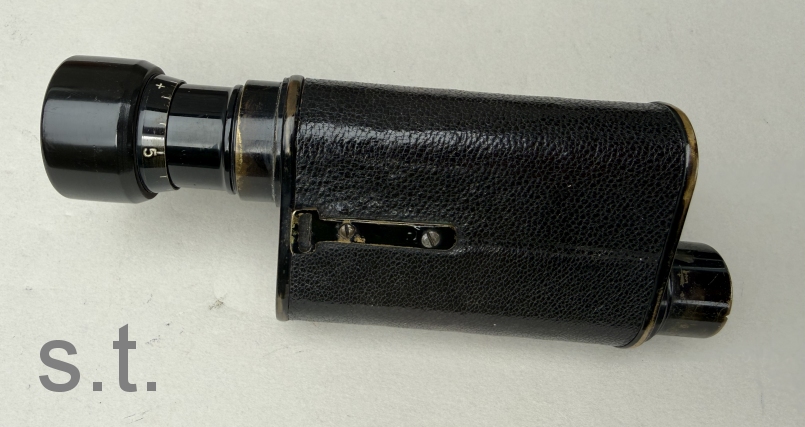
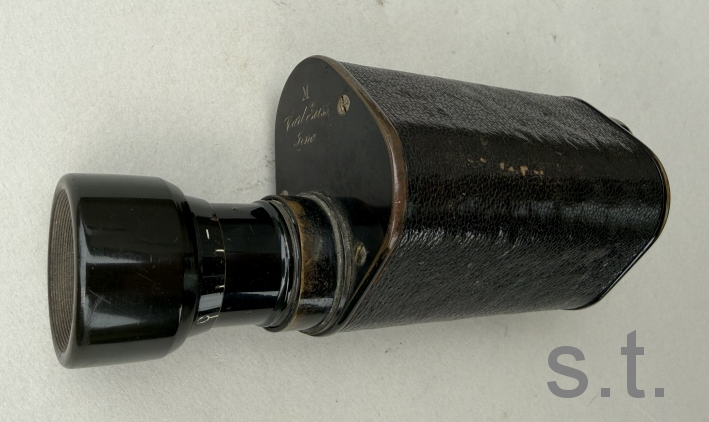
| Das 8x20 Monokular ist etwa 165 mm lang, wobei der Korpus eine Länge von 87 mm aufweist. Das Gehäuse ist ca. 65 mm hoch und 46 mm breit. Es wiegt 403 g und ist somit wesentlich schwerer als andere 8x20 Modelle zu der Zeit. | The 8x20 monocular is about 165mm long, whereof the body is 87mm long. The housing is about 65mm high and 46mm wide. It weighs 403 g and thus is significantly heavier than other 8x20 models of that time.is . |
Fotos: S. Tomlinson