Carl Zeiss (blc) Beobachtungsfernrohr 6x30
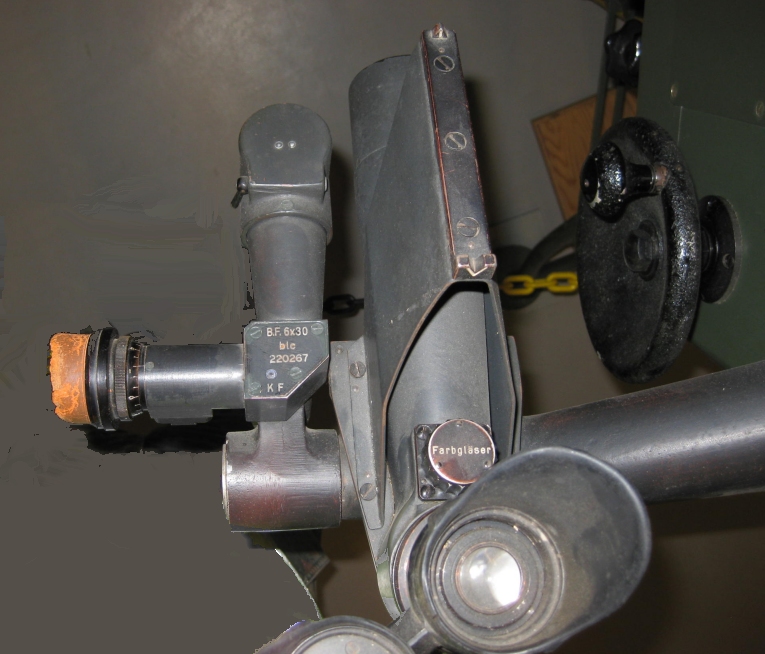
| Das Beobachtungsfernrohr 6x30 mit 90° Einblick wurde als Zusatzoptik zum 10x45 am Kommandohilfsgerät 35* benutzt. Je nach Herstellungszeit vor oder im 2. Weltkrieg finden sich der Firmenname "Carl Zeiss Jena" oder der Herstellercode "blc" an der Abdeckplatte der Gehäuseseite. Die vorliegenden Exemplare sind mit dem Zeiss-Linsenlogo und links bzw. rechts davon mit "6x" und "8,5°" gekennzeichnet, darunter die fünfstellige Seriennummern "No. 74731" bzw. "94255". Letzteres ist auch mit "KF" und "+" für das verwendete Kältefett graviert; ein weiteres Exemplar mit Nummer 172088 ist über dem Logo mit "B.F. 6x30" und unter diesem mit "Hersteller: Winkel" gekennzeichnet - es wurde also in den Göttinger Winkel-Werken , die Teil der Zeiss-Gruppe waren, gefertigt (Varianten, s. Fotos). | The 6x30 observation telescope with a 90° eyepiece was used as an auxiliary optic alongside the 10x45 model on the "Kommandohilfsgerät 35"* (auxiliary fire-control instrument). Depending on whether they were manufactured before or during World War II, the side cover plate bears either the company name "Carl Zeiss Jena" or the manufacturer code "blc." The units shown here feature the Zeiss lens logo, flanked by "6x" and "8.5°," with the five-digit serial numbers "No. 74731" and "94255" appearing below. The latter also bears engravings of "KF" and "+" to indicate the cold-resistant grease used; another unit (serial number 172088) is marked "B.F. 6x30" above the logo and "Hersteller: Winkel" (Manufacturer: Winkel) below it, indicating it was produced at the Winkel works in Göttingen—part of the Zeiss Group (see photos for variants). |
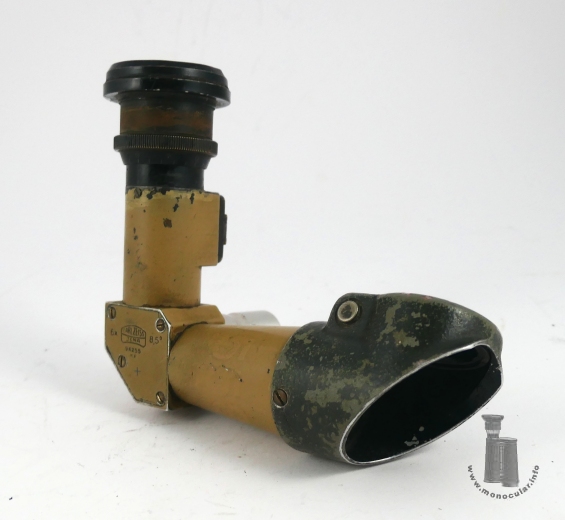
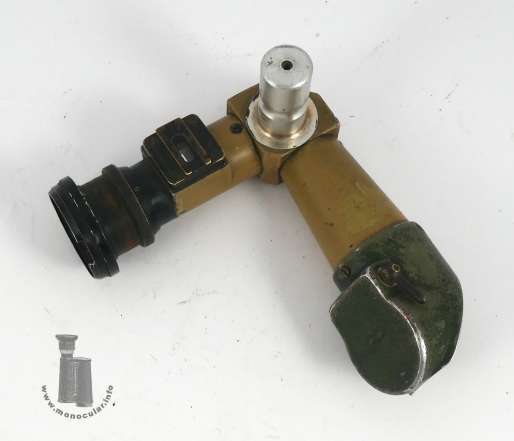
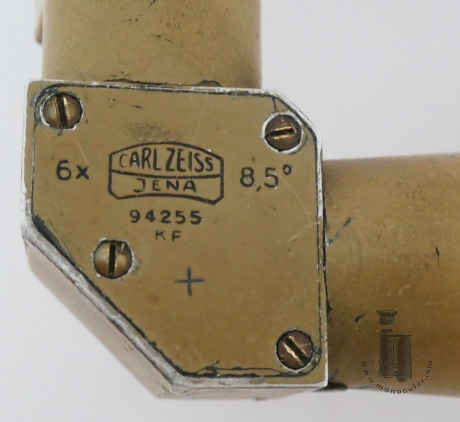
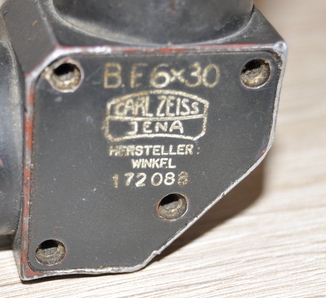
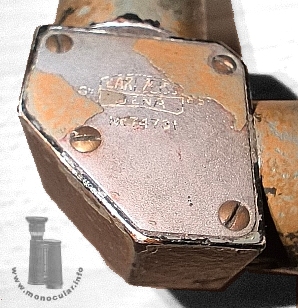
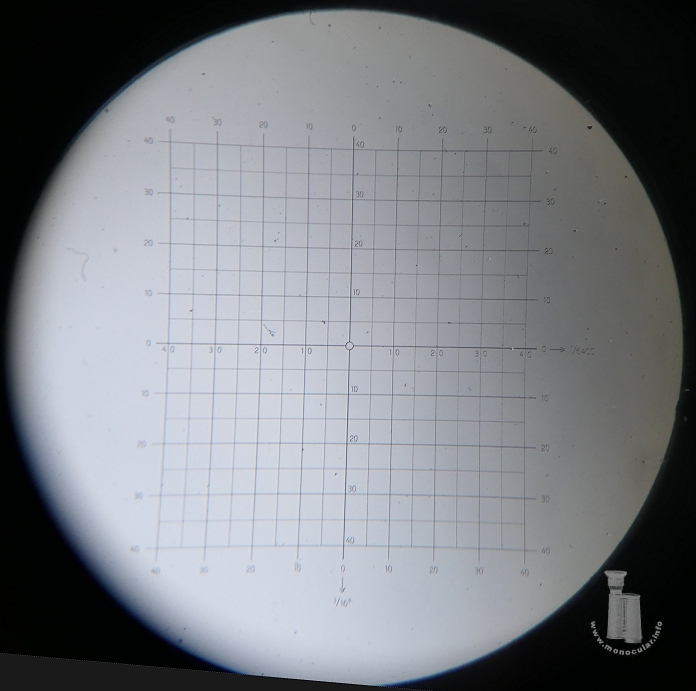
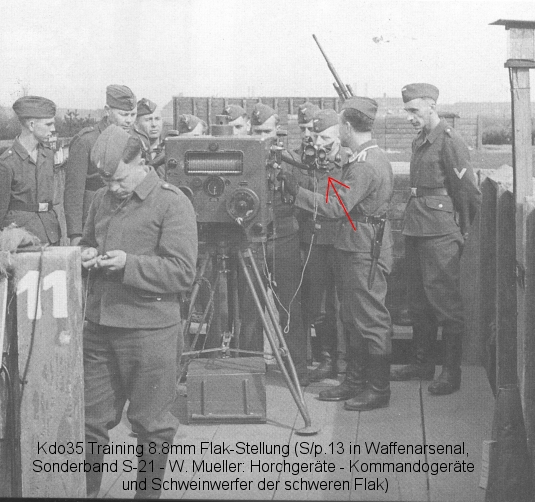
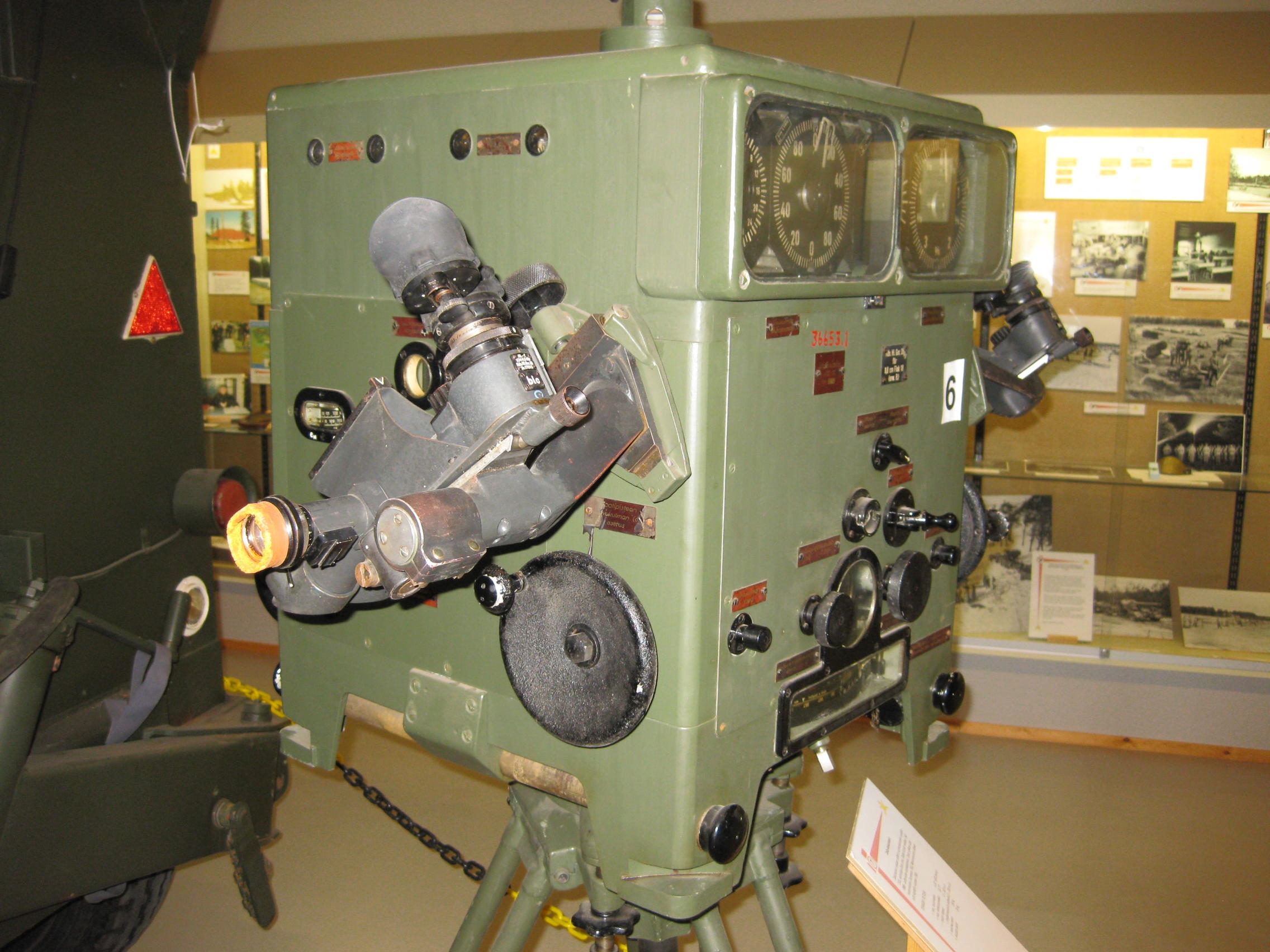
| Das sandfarben oder grau lackierte 6x30 aus Aluminium hat ein sechseckiges Prismengehäuse, einen konischen Objektivtubus und einen Okulartubus. Das Gehäuse enthält ein 90° Dachkantprisma, welches für die Nutzung eines seitlichen Einblicks mit Ausblick nach vorne oben benötigt wird. Gegenüber dem beschrifteten Gehäusedeckel ist ein Montagezapfen eingegossen, mit dem das Fernrohr an dem Montage- bzw. Tragarm des Kommandohilfsgeräts 35 auf der linken Seite befestigt wird (s. Foto). Am Objektivtubusende ist ein abgeschrägtes Sonnenblendrohr geschraubt, in dem sich mittels eines Hebels außen ein Grünfilter vorklappen lässt. Der Okulartubus hat ein Beleuchtungsfenster und schließt mit einem schwarz lackierten Okularstück mit komplett darum laufender Dioptrienskala (+/-5), einem dünnen vertikal geriffelten Fokussierungsring (|||) und einem metallenen Trägerring für eine Gummiaugenmuschel ab. Die Strichplatte hat ein Visier- und Zielkorrekturgitter (Koordinatensystem) mit jeweils 5er Schritten von 0-40. Dabei ist die Horizontal mit 1/6400, die Vertikale mit 1/16° zu bestimmen. |
The sand-colored or gray-painted aluminum 6x30 has a hexagonal prism housing, a conical objective tube, and an eyepiece tube. The housing contains a 90° roof prism, required to enable side-viewing with a forward-upward line of sight. Opposite the labeled housing cover, a mounting trunnion is cast into the unit; this is used to attach the telescope to the mounting or support arm of the "Kommandohilfsgerät 35" (auxiliary fire-control instrument) on the left side (see photo). A beveled sunshade tube is screwed onto the end of the objective tube; it houses a green filter that can be flipped into position using an external lever. The ocular tube features an illumination window and terminates in a black-painted eyepiece assembly comprising a full-circumference diopter scale (+/-5), a thin, vertically ribbed focusing ring (|||), and a metal mounting ring for a rubber eyecup. The reticle features a sighting and aiming correction grid (coordinate system) marked in increments of 5, ranging from 0 to 40. Horizontal measurements are based on 1/6400 units, while vertical measurements are based on 1/16°. |
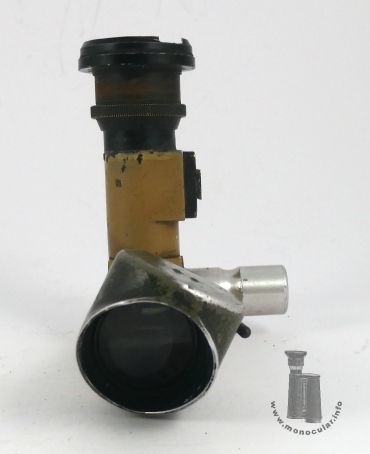
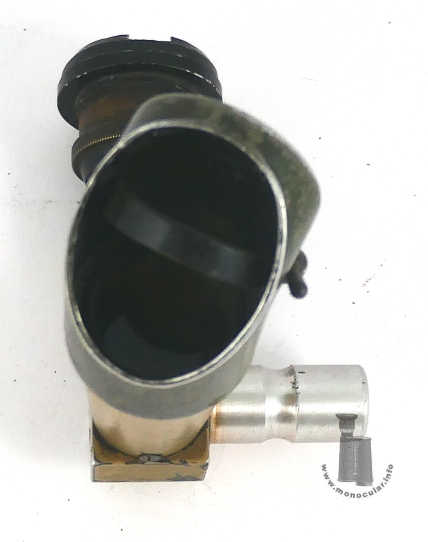
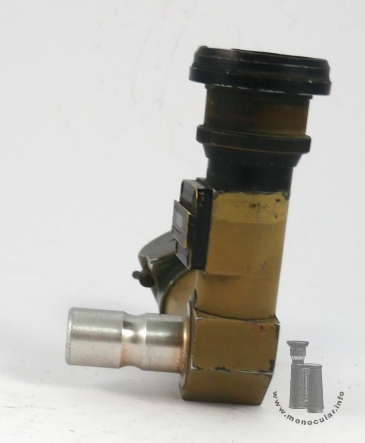
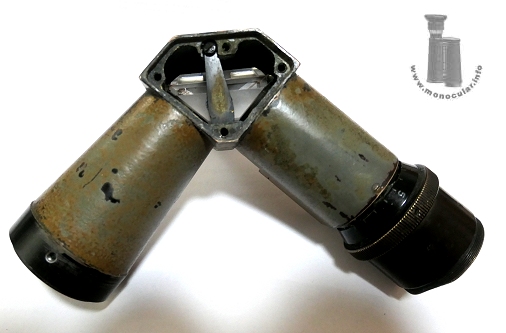
| Das kleine Beobachtungsfernrohr wiegt 391g. Der Objektivtubus ist 60 mm lang und verbreitert sich von 29 auf 38mm, die Sonnenblende misst 42, beim Filterbehältnis 48mm und der 42mm lange Okulartubus 30mm im Durchmesser. Das Okularstück ist 29mm, der Fokussierungsring 37mm und der Augenmuschelträgerring 46mm im Durchmesser. Das Prismengehäuse ist 36x35x30 mm groß. Vom Gehäuse bis zum Sonnenblendschutz sin es 140mm. Der Montagezapofen ist 40mm lang. | The small sighting scope weighs 391 g. The objective tube is 60 mm long and widens from 29 mm to 38 mm; the sunshade measures 42 mm, the filter housing 48 mm, and the 42 mm long eyepiece tube is 30 mm in diameter. The eyepiece tube has a diameter of 29 mm, the focusing ring 37 mm, and the eyecup mount ring 46 mm. The prism housing measures 36 x 35 x 30 mm. The length from the housing to the sunshade is 140 mm. The mounting trunnion is 40 mm long. |
| * Infos zur Funktionsweise der Kommandogeräte (Rechner) finden sie unter den Artikeln von Adnre Masson bei Analogrechnermuseums oder hier. | * Information on how the fire-control devices (computers) work can be found in the articles by André Masson at the Analog Computer Museum or here. |
Fotos: Zeun; Internet/Museum