Waechter "Mondianans" 7x28
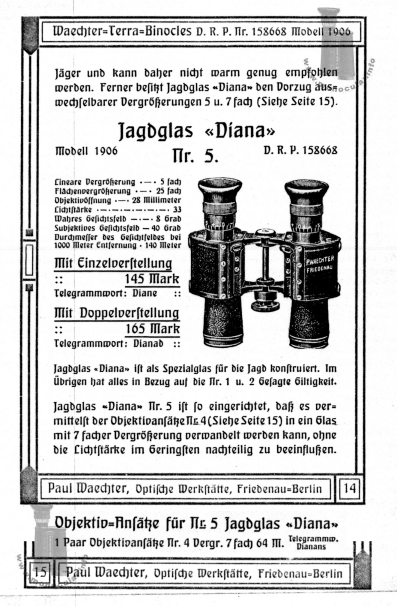
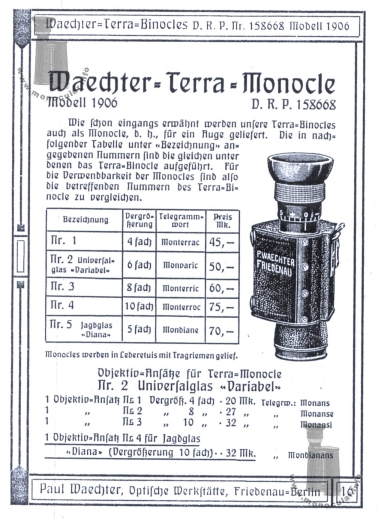
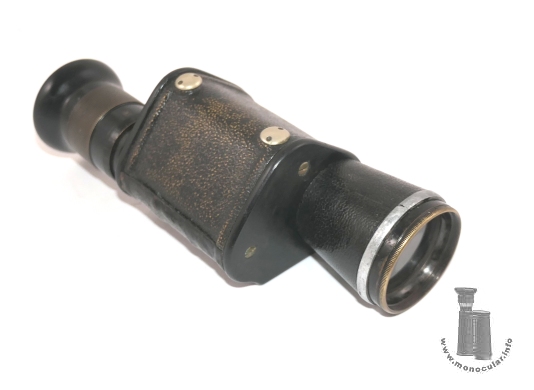
| Ein sehr seltenes Monokular ist das hier gezeigte von der Firma Paul Waechter aus Berlin-Friedenau, die vor allem Mikroskope produzierte. Ein Katalog von 1906 verdeutlicht, dass zumindest um diese Zeit Waechter einige eigene Prismenferngläser herstellt, wobei einer Besonderheit war, dass es den Fernrohrkörper mit verschiedenen Objektivansätzen gab, so dass unterschiedliche Vergrößerungen erreicht wurden. Das Monokular ist ein Modell Nr. 5 Jagdglas "Diana" mit einem Objektiv-Ansatz Nr. 4, womit eine 7fache Vergrößerung mit einem 28mm Objektiv erreicht wird (s. Katalog, Angaben zum Fernglas, S. 14, wobei auf S. 16 bei den Monokularen für den Objektiv-Ansatz Nr. 4 fälschlicherweise eine 10fache Vergrößerung genannt wird). Das Telegrammwort für dieses Modell lautet "Mondianans". (s. Katalogseiten u.) |
The monocular shown here—a very rare one—was made by the firm Paul Waechter of Berlin-Friedenau, a company primarily known for producing microscopes. A 1906 catalog reveals that, at least during that period, Waechter produced in its own workshop several prism designs; one notable feature was that the telescope body could be fitted with various interchangeable objective attachments, thereby allowing for the different magnifications. This particular monocular is a Model No. 5 "Diana" hunting glass fitted with a No. 4 objective attachment, yielding a 7x magnification with a 28mm objective lens (see catalogue, specifications for binoculars, p. 14; note, however, that on p. 16 within the monocular section the No. 4 objective attachment is erroneously listed as providing 10x magnification). The telegraphic code word for this model is "Mondianans" (see catalogue pages below). |
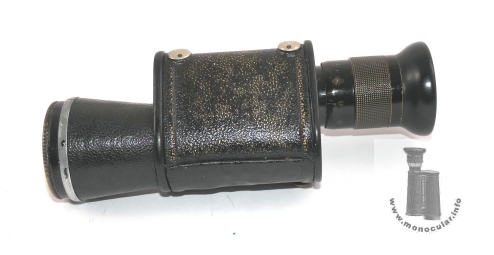
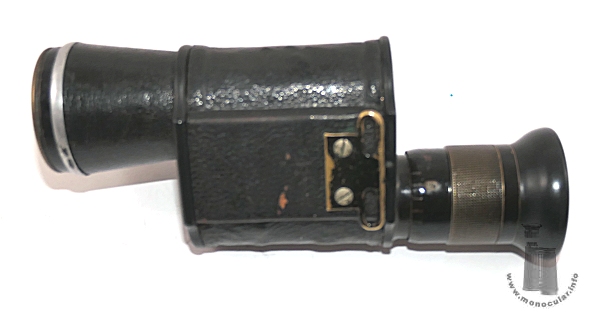
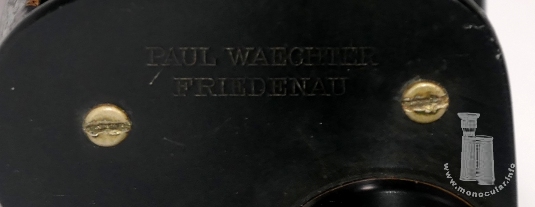
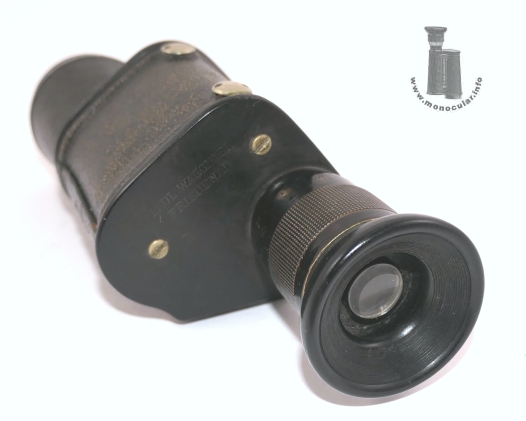
| Das Monokular ist aus einem mit dunkelbraunen Leder ummantelten Aluminium-Gehäuse und -Objektivtubus gefertigt, während das Okular, Trageriemenöse und Objektivfassung aus (schwarz lackiertem) Messing sind. Die 1/3 Augenmuschel ist aus Hartgummi. Die Deckel- und Gehäusegrundform ähnelt den Goerz-Monokularen in ihrer mehr dreieckigen Form mit abgerundeten Ecken. Die zweifach verschraubten Deckel sind lediglich Abdeckungen für das Gehäuse mit dem Prismenstuhl. Sie sind aus dunkelbraunen Hartgummi wie bei den Aitchison-Modellen. Im oberen Deckel ist "Paul Waechter Friedenau" eingeprägt. Da aufgrund der Wechselobjektive eine 5- oder 7fache Vergrößerung möglich war, ergibt es Sinn, dass das Grundgehäuse keine Vergrößerungsangabe aufweist. |
The monocular is constructed from an aluminum body and objective tube covered in dark brown leather, while the eyepiece, the strap lug, and the objective mount are made of (black-painted) brass. The eyecup is made of hard rubber. The basic shape of the covers and housing resembles that of Goerz monoculars, characterized by a somewhat triangular form with rounded corners. The covers, secured by two screws, serve merely as coverings for the housing containing the prism cage. They are made of dark brown hard rubber, similar to those found on the Aitchison models. The inscription "Paul Waechter Friedenau" is embossed on the upper cover. Since a magnification of 5x or 7x was possible through the use of interchangeable objectives, it makes sense that the main housing itself bears no indication of magnification. |
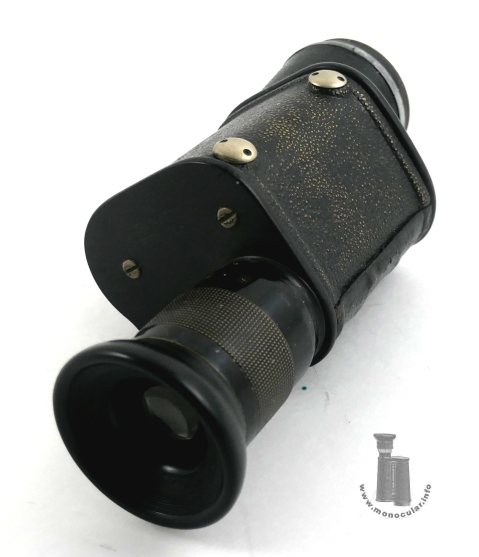
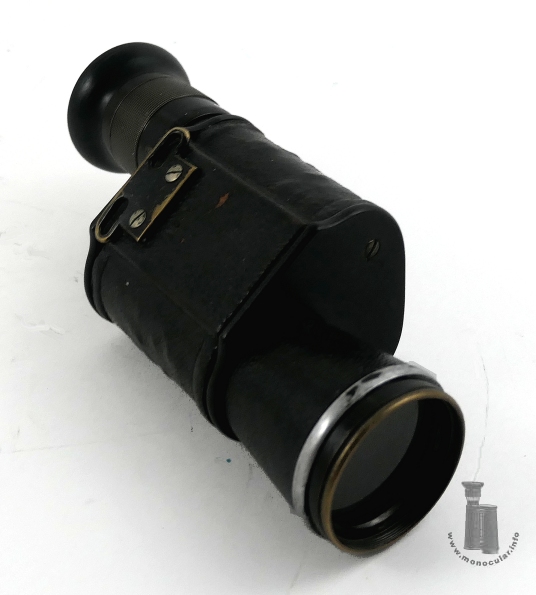
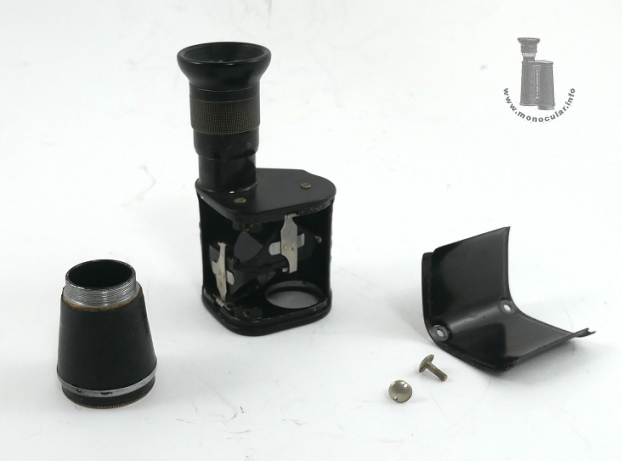
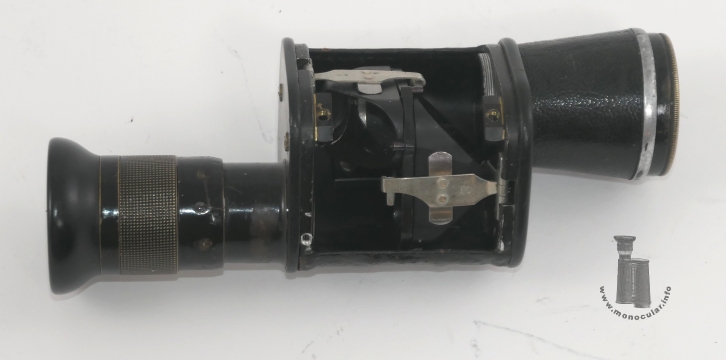
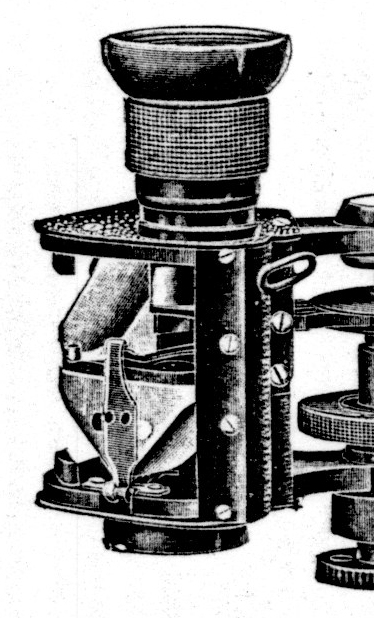
| Eine Seite des Gehäuses ist nach außen gewölbt und bildet eine rechteckige Fläche. An dieser ist oben ein Messingplättchen mit zwei nebeneinander liegenden Trageriemenösen angeschraubt, wodurch ein Trageband an beiden Enden eingehängt werden konnte. Innen stellt es den Haupträgerplatte des Prismenstuhls dar. Denn die weitere Gehäusewand lässt sich nach Lösen der beiden Zweilochschrauben abnehmen, um eine Säuberung, Justierung oder Reparatur des Prismensystems vorzunehmen. Die Porro-I-Prismen sind am Prismenkäfig mit Metallklammern fixiert. (vgl. Katalogausschnitt) Der Objektivtubus ist konisch und in dem unteren Deckel und Gehäuseboden eingeschraubt. Das Okular hat eine komplett umlaufende Dioptrienskala von +7 bis - 12, gekennzeichnet bei null und fünf und mit + und -. Der Fokussierungsteil hat eine Plus-Kreuzriffelung (‡‡). Die Sicherungsschraube für das Okularstück fehlt. |
One side of the housing is protruding, forming a rectangular surface. A brass plate with two adjacent carrying strap lugs is screwed to the top of this surface, allowing a shoulder strap to be attached at both ends. Inside, this plate serves as the main support for the prism chair. The remaining housing wall can be removed by loosening the two double-hole screws for cleaning, adjusting, or repairing the prism system. The Porro I prisms are fixed to the prism cage with metal clamps. (cf. catalogue clip) The objective tube is conical and screwed into the lower cover and base of the housing. The eyepiece has a continuous diopter scale from +7 to -12, marked at zero and five with + and -. The focusing mechanism has a plus cross-hatching pattern (‡‡). The locking screw for the eyepiece is missing. |
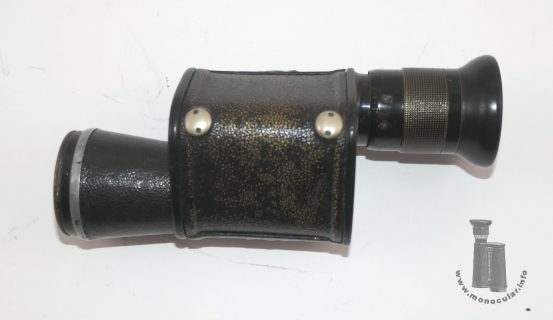
| Das "Mondianans" ist 125-137mm lang, dabei ist das Gehäuse nur 50mm und der Objektivtubus 35mm lang. Das Gehäuse misst 46x43x53mm. Der konische Tubus ist 27,5 - 34,5mm, die Objektivfassung 33mm im Durchmesser. Das Okularstück ist 22mm, der Fokussierungsring 26mm und die Augenmuschel 34,5. Das 7x28 wiegt 232g. Der passende zylindrische Lederköcher wiegt 160g. | The "Mondianans" is 125–137 mm long; of this, the body measures only 50 mm and the objective tube 35 mm. The body measures 46 × 43 × 53 mm. The conical tube measures 27.5–34.5 mm, and the objective frame 33 mm in diameter. The eyepiece is 22 mm, the focusing ring 26 mm, and the eyecup 34.5 mm in section. The 7x28 model weighs 232 g. The matching cylindrical leather case weighs 160 g. |
Fotos: Ebay, Zeun