S.R.P.I. Puteaux 20x/40x70
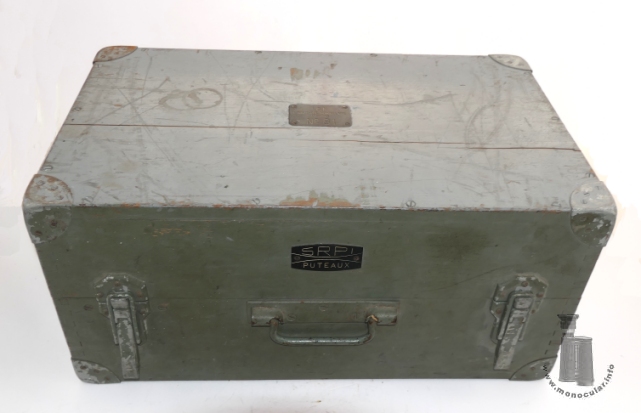
| Das von S.R.P.I. gefertigte Prismen-Richtfernrohr ist an der runden (Ober)Seite unter dem SRPI-Puteaux-Logo mit "1944 I.G.N. Longue-vue monoculaire No. 81" graviert. Es dürfte somit das 81. Exemplar aus 1944 sein — ein weiteres bekanntes Exmplarr hat die Nr. 23 aus 1942. I.G.N steht für Institut Géographique National, der französischen Behörde für Landvermessung und Kartografie und ist 1940 die Nachfolgeeinrichtung des Service Géographique de l’Armée (SGA). Der grau lackierte Holztransportkasten hat auf dem Deckel die ähnlich lautende Bezeichnung "I.G.N. Mle 1944 No 81", graviert in einem eingelassenen schwarzen Metallschild (Mle. = Modèle). An der Deckelvorderseite befindet sich wiederum das Firmenlogo auf einem Schild. Das Prismenfernrohr hat einen Okularrevolver mit zwei Okularen der Vergrößerung 20x und 40x. Beide Okulare haben eine Dioptrieneinteilung von plus 2 bis minus 5. Es gibt eine Strichplatte mit einem durchgehenden senkrechten und einem kurzen mittigen Strich. Die Optik ist unvergütet. |
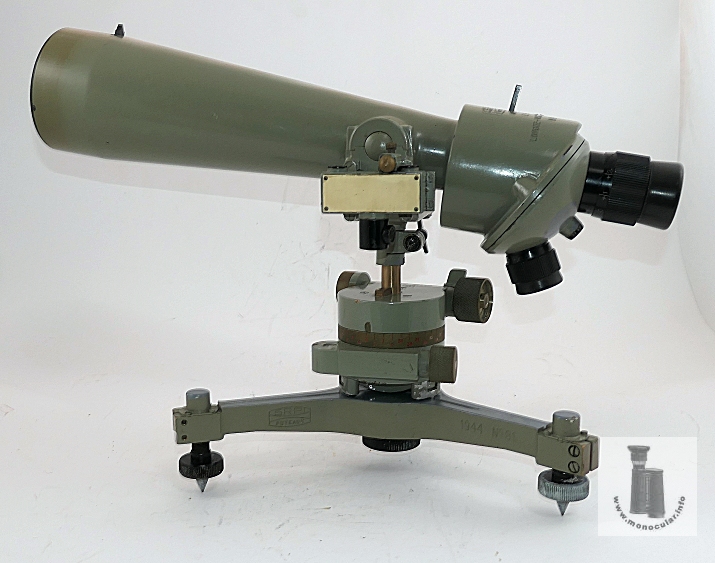
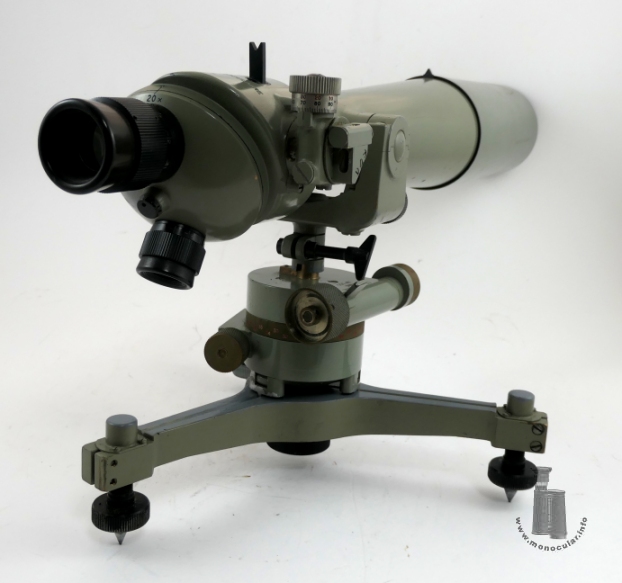
The prismatic spotting scope manufactured by S.R.P.I. is engraved on its round (top) side, beneath the SRPI-Puteaux logo, with the inscription "1944 I.G.N. Longue-vue monoculaire No. 81." It is therefore likely the 81st unit produced in 1944. I.G.N. stands for "Institut Géographique National" (National Geographic Institute), the French land surveying and cartography agency; established in 1940, which succeeded the "Service Géographique de l’Armée" (SGA). The grey-painted wooden transport case has a similar inscription, i.e. "I.G.N. Mle 1944 No 81" (where "Mle." stands for "Modèle"), engraved on a black metal plate recessed into the lid. The company logo appears on another plate on the front of the lid. The prism telescope is equipped with a rotating eyepiece turret featuring two eyepieces offering 20x and 40x magnification. Both eyepieces have a diopter adjustment range of +2 to -5. It includes a reticle consisting of a continuous vertical line and a short central line. The optics are uncoated. |
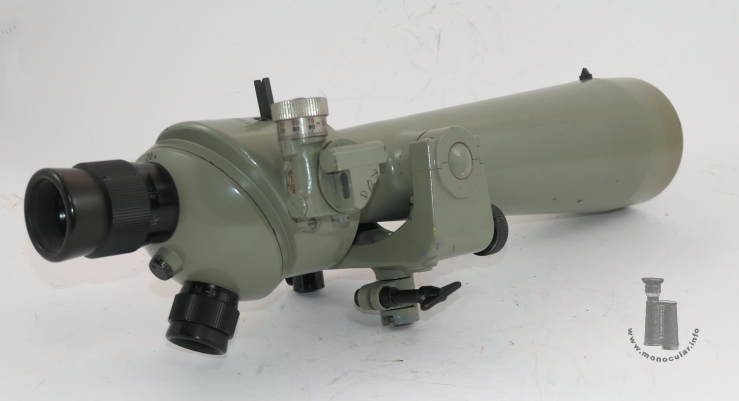
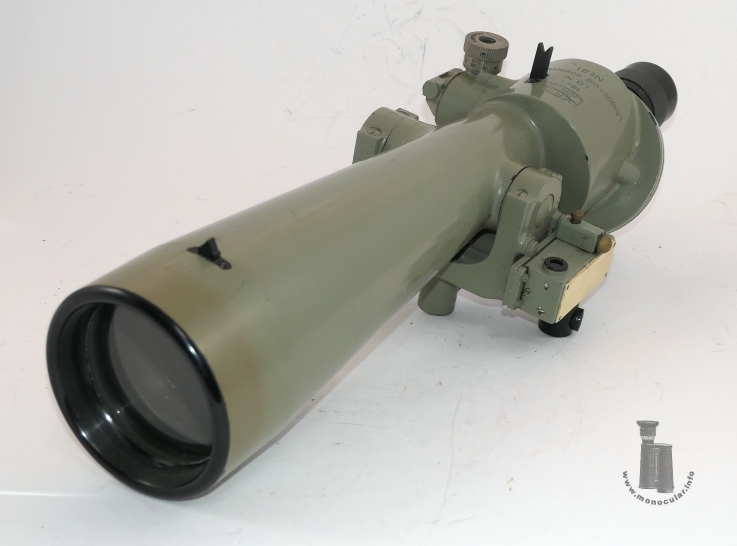
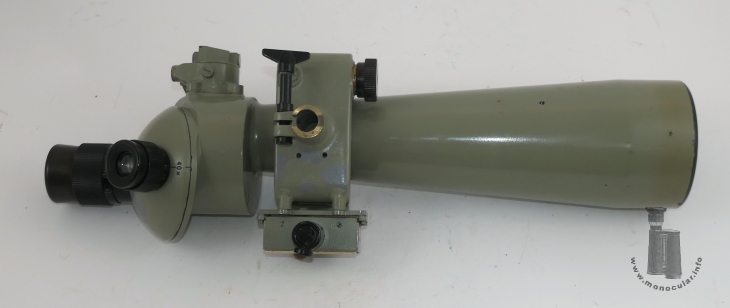
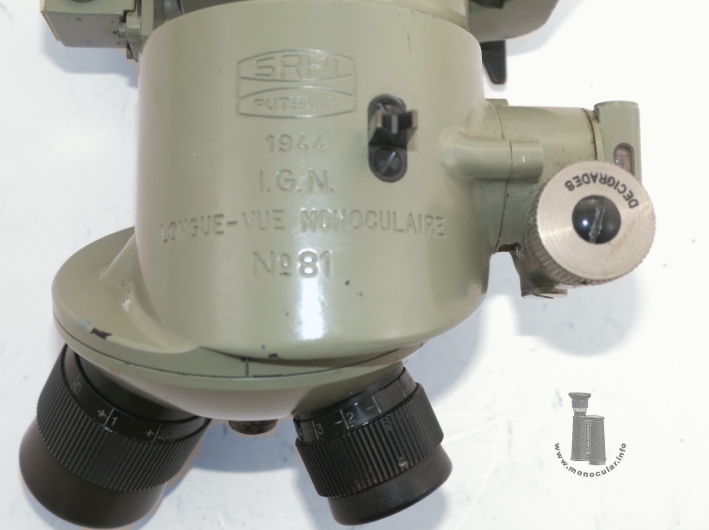

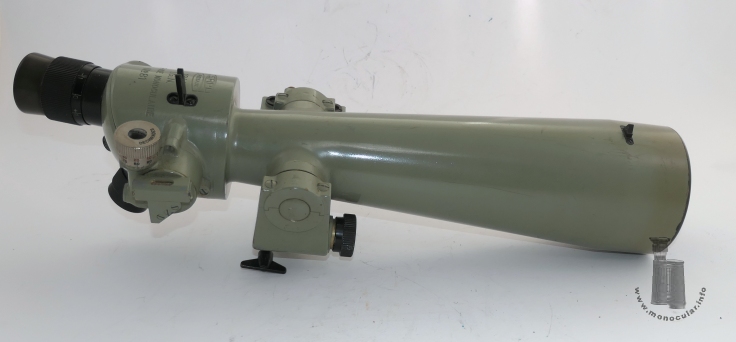
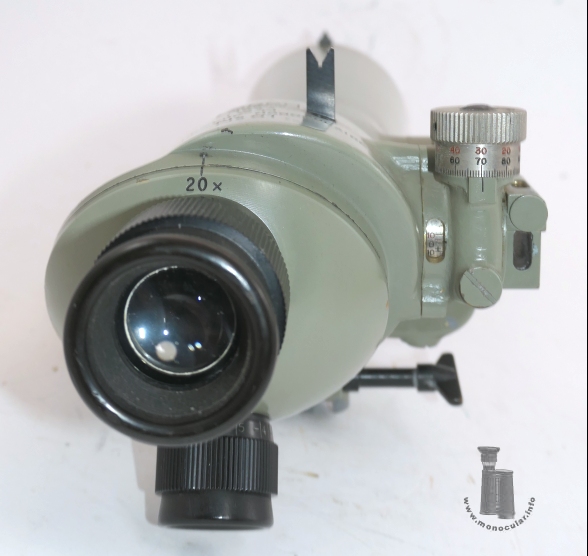
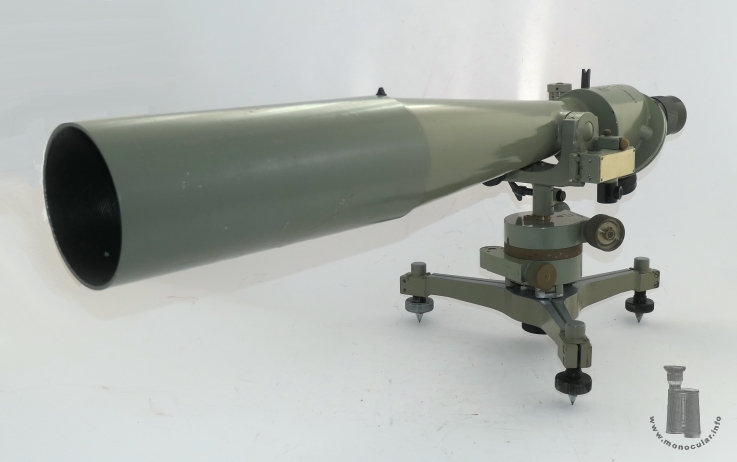
| Das grün-grau lackierte Prismenfernrohr hat eine Kimme-Korn-Vorrichtung und ein 70mm Objektiv. Auf das Objektiv lässt sich ein grau lackiertes Regenschutzrohr bzw. eine Sonnenblende stecken. An der rechten Gehäuseseite ist eine Wasserwaagelibelle befestigt, die in ihrem Gehäuse oben ein Fenster und zum Beobachter hin ein per Spiegel umgelenktes Fenster hat, um das Fernrohr zu justieren. Dabei lässt sich die Wasserwaage anhand eines oben liegenden Stellrads kippen. Das Stellrad ist auf der Oberseite mit "Decigrades" gekennzeichnet und hat eine rote Minus- und eine schwarze Plusskala von Null bis 90 (bzw. 100); der Beobachter kann in einer zu ihm gerichteten Öffnung die Neigung von + (schwarz)/- (rot) 10 ablesen. Das Fernrohr ist auf einer Stativgabel montiert. Dieses lässt sich mittels eines Drehknopfes ebenfalls neigen. Auf der linken Gabelhalterung ist ein Kompass in einem rechteckigen Gehäuse aufgeschraubt. Das Kompassgehäuse hat oben zwei kleine runde Lichtfenster, seitlich eine phosphoreszierende Platte und unten eine schwarz lackierte drehbare Hülse mit seitlichem Ablesefenster der Kompassnadel. Letztere lässt sich mit einem Federmechanismus an der Oberseite arretieren und lösen. Das Kompass-Teil wurde von Huet Paris gefertigt, wie die Gravur des Logos auf diesem zeigt. | The green-grey painted prismatic telescope features an open sight (notch and foresight) and a 70mm objective lens. A grey-painted rain shield or sunshade can be attached to the objective. A spirit level is mounted on the right side of the housing; its casing features a window at the top and another facing the observer—utilizing a mirror—to facilitate telescope adjustment. The spirit level can be tilted using a top-mounted adjustment wheel. This wheel is marked "Decigrades" and features both a red minus scale and a black plus scale ranging from zero to 90 (or 100); the observer can read the inclination—ranging from + (black) to - (red) 10—through an aperture facing them. The telescope is mounted on a tripod yoke, which can also be tilted via a rotary knob. A compass housed in a rectangular casing is screwed onto the left yoke mount. The compass housing features two small round windows on top, a phosphorescent plate on the side, and a black-painted rotating sleeve at the bottom with a side-facing window for reading the compass needle. The needle can be locked and released using a spring mechanism located on top. The compass unit was manufactured by Huet Paris, as indicated by the engraved logo. |
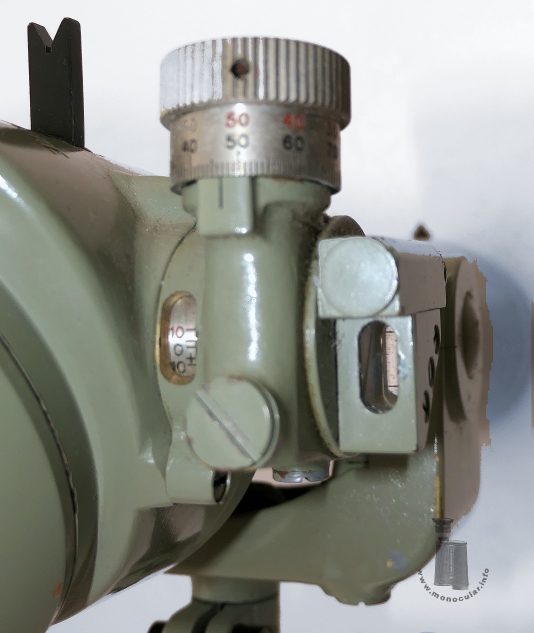
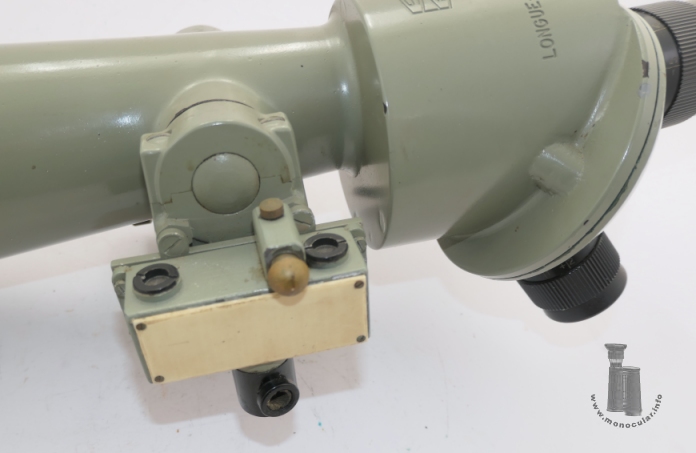
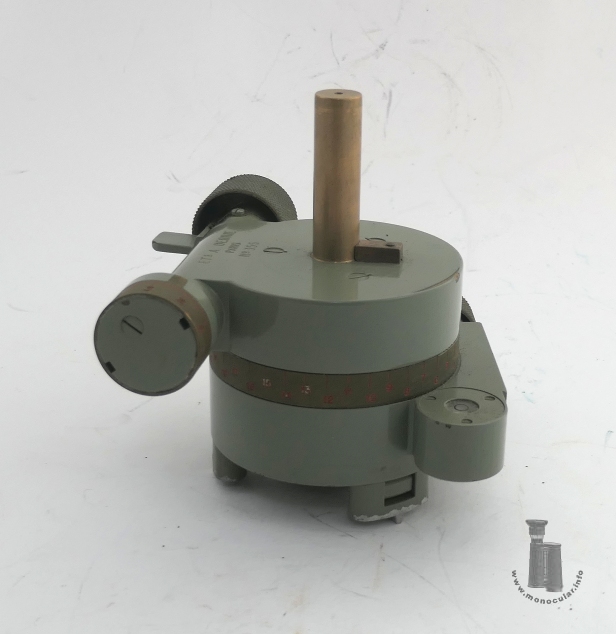
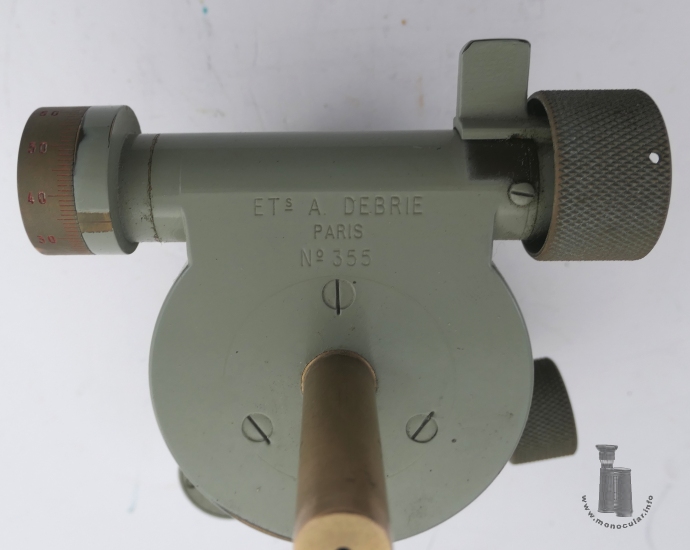
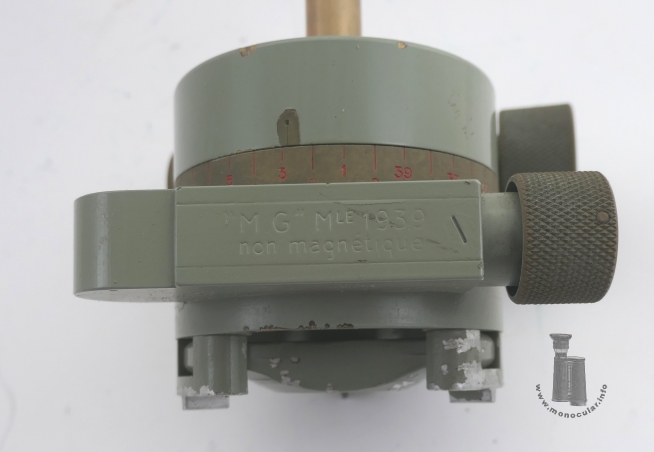
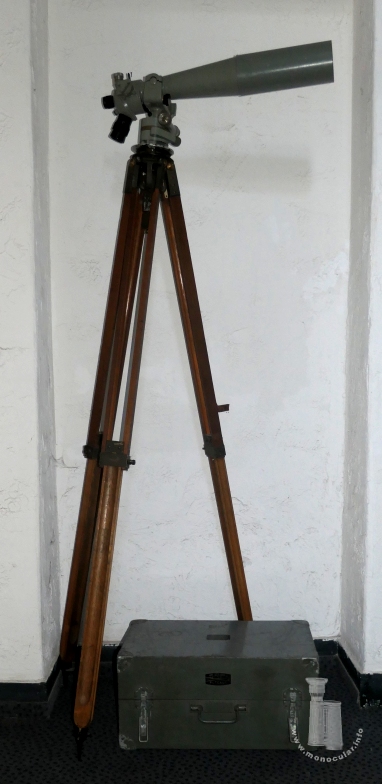
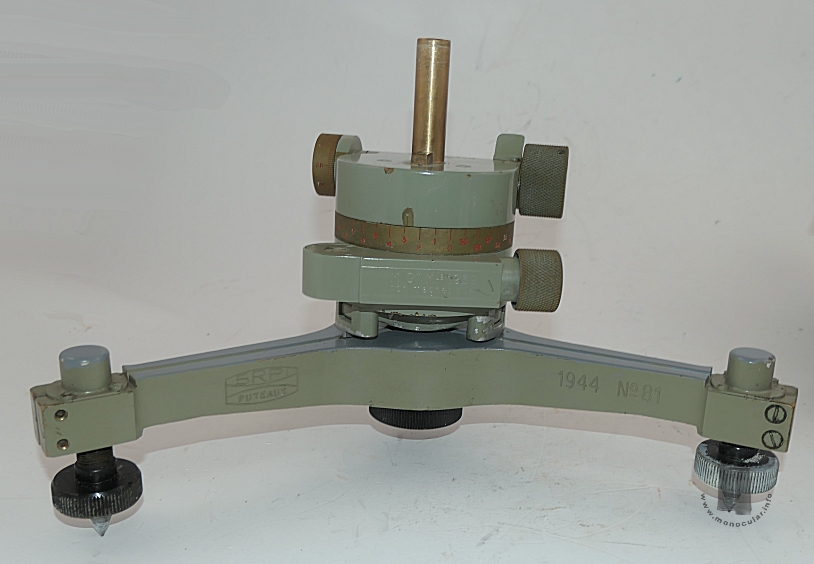
| Außer dem Regenrohr gibt es für das Objektiv eine Lederschutzkappe (innen mit Teilenummer 94 gestempelt), einen Richtkreis, ein Tischdreibein mit justierbaren Nivellierdornen sowie ein Dreibeinstativ aus Holz und Metall. Alle Zubehörteile außer dem Holzstativ lassen sich in der Transportkiste verstauen. Der Richtkreis wird entweder an des Tisch- oder Holzstativ geschraubt, das Fernrohr auf den Zapfen des Richtkrieses gesteckt und mit einer Flügelschraube festgezurrt. Das Tischdreibein ist ebenfalls grün-grau lackiert und passend an zwei Armen mit dem Firmenlogo sowie wiederum "1944 No 81" gekennzeichnet. Der Richtkreis ist auf der Oberseite mit dem Hersteller "ETs A. Debrie Paris No 335" (vorrangig ein Filmkameraproduzent) und an der geraden unteren Gehäuseseite mit '"M.G." MLE 1939 non magnétique' (Ministre de Guerre = Kriegsministerium, Modell 1939 nicht magnetisch) gekennzeichnet. An dieser Seite ist auch eine runde Blasen-Wasserwaage. Der Richtkreis lässt sich mit Stellrädern zur Feinjustierung horizontal ausrichten. Die zwischen den optional nutzbaren Stellrädern liegende Skala reicht von Null bis 39 bzw. 40, mit roten Ziffern gekennzeichnet an abwechselnd kürzeren und längeren Strichen. Zur Schnellverstellung lässt sich durch einen Kipphebel das Zahngetriebe lösen und so der obere Teil des Richtkreises frei drehen. |
In addition to the rain shield, accessories for the objective include a protective leather cap (stamped inside with part number 94), an aiming circle, a tabletop tripod with adjustable leveling spikes, and a tripod made of wood and metal. All accessories except the wooden tripod can be stowed in the transport case. The aiming circle is screwed onto either the tabletop or wooden tripod; the telescope is then mounted onto the aiming circle's pivot and secured with a thumbscrew. The tabletop tripod is also painted green-grey and bears the company logo on two of its legs, along with the marking "1944 No 81." The aiming circle is marked on the top with the manufacturer "ETs A. Debrie Paris No 335" (primarily a film camera manufacturer) and on the straight lower side of the housing with '"M.G." MLE 1939 non magnétique' (Ministre de Guerre = Ministry of War, Model 1939 non-magnetic). A circular bubble level is also located on this side. The aiming circle can be aligned horizontally using adjustment wheels for fine-tuning. The scale situated between the optional adjustment wheels ranges from zero to 39 or 40, featuring red numerals marking alternating short and long graduations. For rapid adjustment, a toggle lever allows the gear mechanism to be disengaged, enabling the upper section of the aiming circle to be rotated freely. |
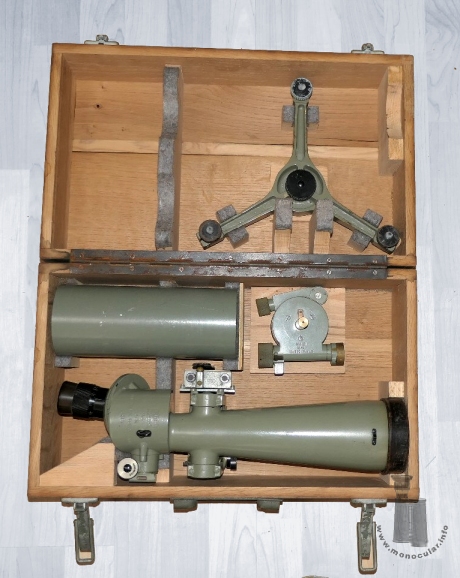
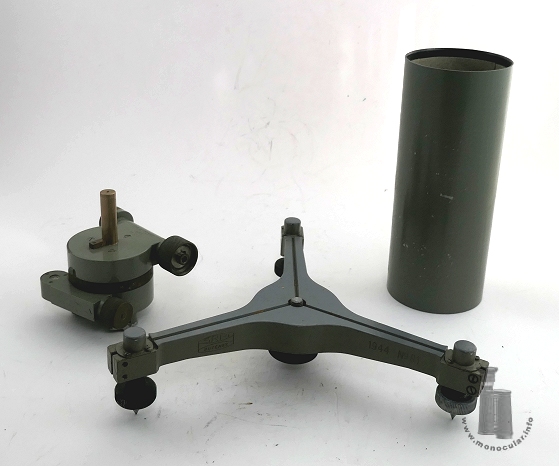
| Das 20x/40x70 wiegt selbst 4045g, der Objektivschutzdeckel 41g, das Regenrohr 406g, der Richtkreis 1836g und das Tischstativ 1880g. Die 48x29x23 große Holzkiste wiegt 8000g. Das Gesamtgewicht beläuft sich somit auf 16,2kg. Das Fernrohr ist je nach Okularauswahl und Dioptrieneinstellung 400 - 440mm lang. Mit aufgestecktem Regenrohr verlängert es sich um 190mm. Der 29cm lange konische Haupttubus verbreitert sich von 48mm auf 90mm im Durchmesser. Das 23cm lange Regenrohr hat einen 94mm Durchmesser. Das Prismengehäuse ist 80mm, der Okularrevolver 90mm im Durchmesser. Beim 20x Okular ist die Okularhülse 38mm, der Fokussierungsring 42,5mm und die Augenmuschel 41mm, beim 40x Okular ist die Hülse 28,5mm, der Fokussierungsring 32mm und die Augenmuschel 30mm im Durchmesser. Die Stativgabel ist ca. 100mm hoch und 110mm breit - mit dem Kompassgehäuse 135mm breit. Der Richtkreis ist ca. 55mm hoch und 74mm im Durchmesser. Der Stativzapfen ist 48mm lang/hoch. Das Tischdreibein ist zwischen 50-60mm hoch und dessen Arme 150mm lang. |
The 20x/40x70 itself weighs 4,045 g; the objective lens cap weighs 41 g, the dew shield 406 g, the azimuth circle 1,836 g, and the table tripod 1,880 g. The wooden case, measuring 48 x 29 x 23 cm, weighs 8,000 g. The total weight thus amounts to 16.2 kg. Depending on the choice of eyepiece and diopter setting, the telescope is 400–440 mm long. Attaching the dew shield adds 190 mm to its length. The 29 cm long conical main tube widens from a diameter of 48 mm to 90 mm. The 23 cm long dew shield is 94 mm in diameter. The prism housing has a diameter of 80 mm, and the eyepiece turret 90 mm. For the 20x eyepiece, the eyepiece sleeve is 38 mm, the focusing ring 42.5 mm, and the eyecup 41 mm in diameter; for the 40x eyepiece, the sleeve is 28.5 mm, the focusing ring 32 mm, and the eyecup 30 mm in diameter. The tripod yoke is approximately 100 mm high and 110 mm wide—or 135 mm wide including the compass housing. The azimuth circle is approximately 55 mm high and 74 mm in diameter. The tripod mounting rod is 48 mm long/high. The table tripod stands between 50 and 60 mm high, and its legs are 150 mm long. |
Fotos: Zeun; 5 A. Lipton