Huet 8x30
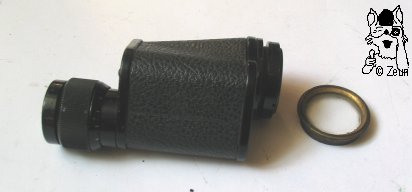
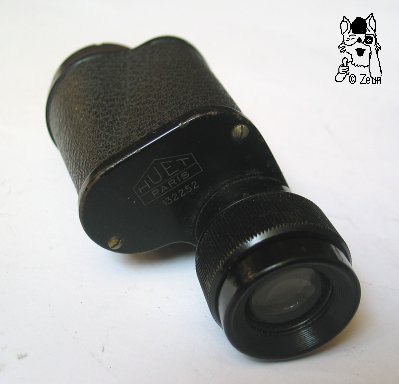
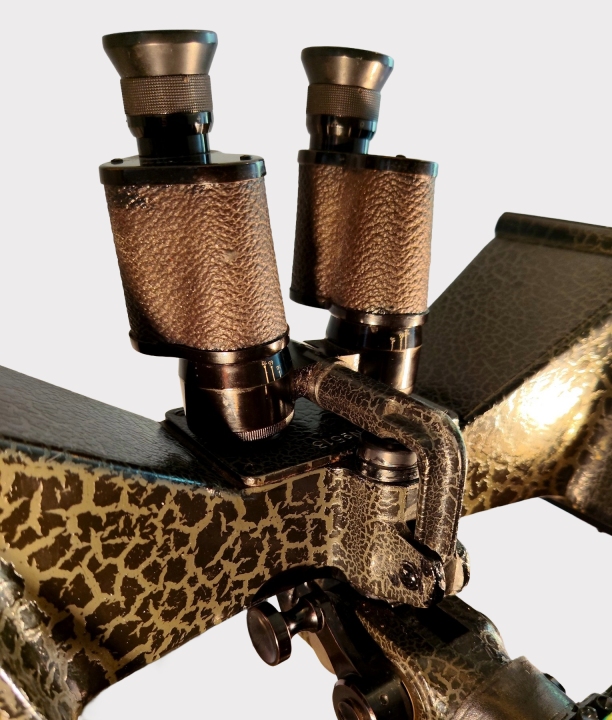
| Dieses 8x30 Huet Monokular mit blauer Vergütung ist eine Nachkriegsversion oder wurde nachvergütet. Es hat die klassischen Merkmale eines Porro-1-Glasses. Der Korpus ist mit Kunstleder ummantelt. Als Besonderheit kann das Außengewinde am Objektivtubus gelten. An diesem war ein Gewindering befestigt. Evtl. diente dies zur Befestigung an einem Huet Spiegel-Stereoskop (s. Foto 3-5). Dies würde auch erklären, warum der Deckel nur mit "Huet Paris - 132252" beschriftet ist, nämlich da es nur ein Monokular von einem Paar für das Stereoskop war. Das 8x30 wiegt 308g. Es ist 11cm lang und das Gehäuse 50x50mm bzw. 52x52mm breit. |
This 8x30 Huet monocular with blue coating is a post-war model. It comes with the characteristic features of a Porro 1 type. The body is covered with synthetic leather. A special feature is a thread outside on the objective tube. A threaded ring was attached to it. This may have functioned to mount it to a Huet mirror stereoscope (see pic. 3). This would also explain why the cover plate is only marked "Huet Paris - 132252". The monocular could then be one of a pair used for the stereoscope. The 8x30 weighs 308g. It is 11cmm tall and the housing measures 50x50mm and 52x52mm. |
| Das Spiegel-Stereoskop von Huet (steréréoscope à miroirs) wurde vom Nationalen Geografischen Institut (IGN) und Militär für Landvermessungs- udn Aufklärungszwecke benutzt. Es gab Versionen in den 1920er und 1930er Jahren. Das vorleigende Monokular wurde entweder nachvergütet oder gehört zu einem Stereoskop nach dem 2. Weltkrieg. | Huet's mirror stereoscope (stéréoscope à miroirs) was used by the National Geographical Institutes (IGN) and the military for land surveying and reconnaissance purposes. Versions of the device were produced during the 1920s and 1930s. The monocular in question was either retrofitted with an anti-reflective coating or belonged to a post-World War II stereoscope. |
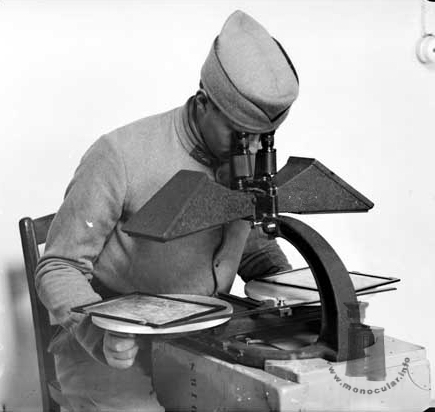
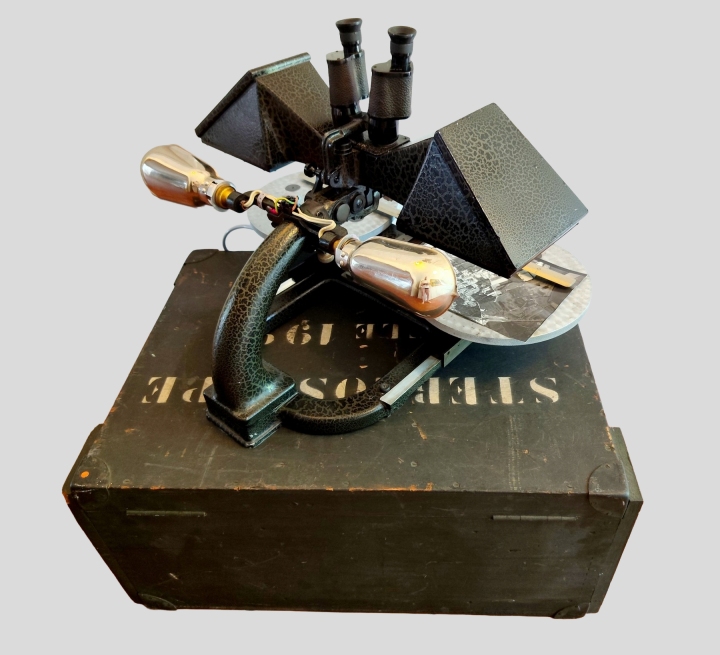
Fotos: Zeun; 3 Manual; 4-5 Auktion (adap.)